
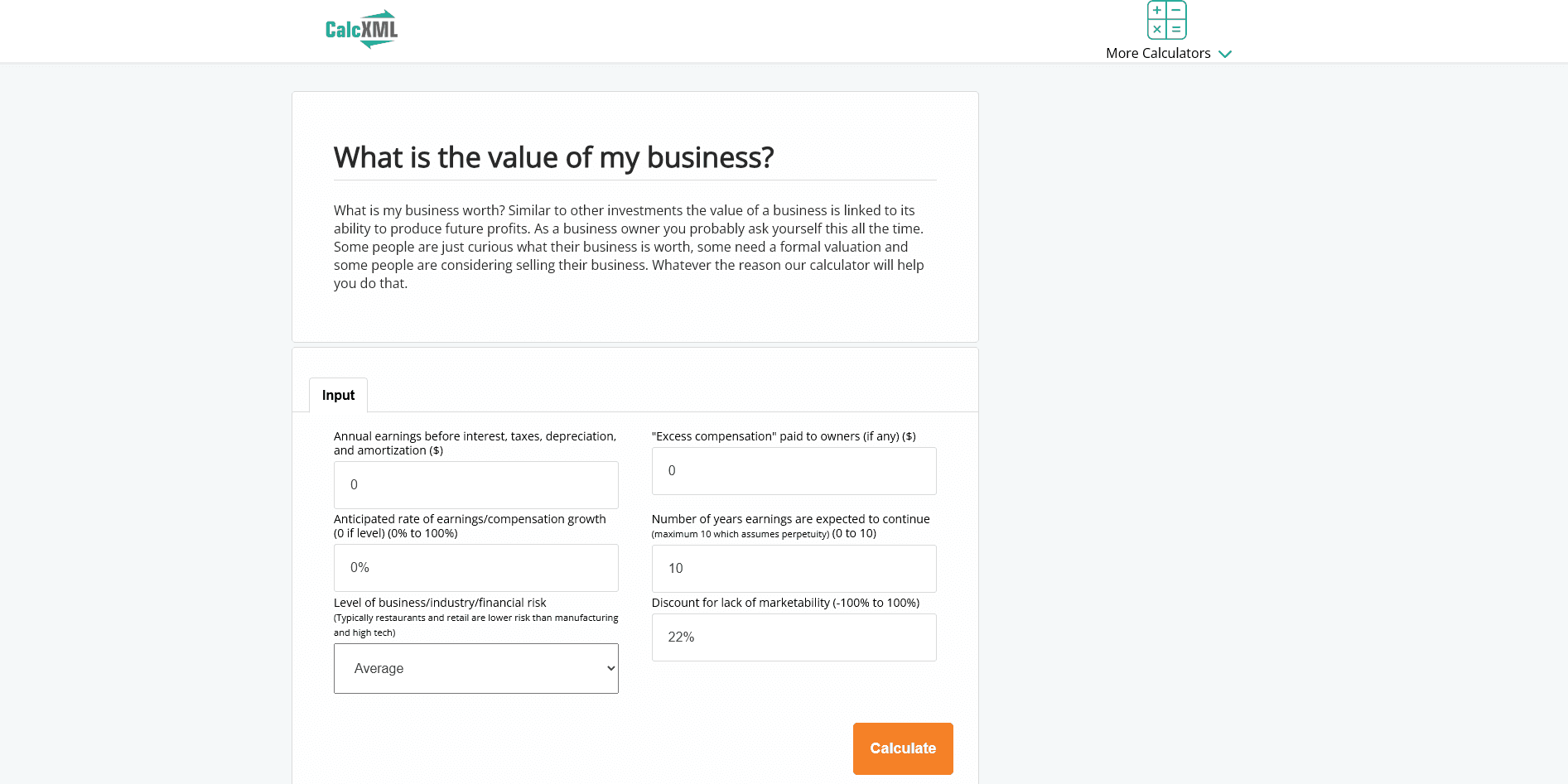
A business valuation calculator estimates what a small business is worth by multiplying its adjusted annual earnings by a multiple drawn from comparable sales. You feed it revenue, profit, and owner compensation, and it returns a range in a few seconds. It is a fast sanity check on an asking price. It is not a valuation.
That distinction is the point of this page. If you are buying with your own cash, it is academic. If you are financing the purchase, the number a calculator gives you and the number your deal turns on come from two different processes, and only one of them counts.
What the calculator is actually doing
Strip away the interface and almost every free tool on the web runs the same two-step arithmetic.
Step one: find the earnings. The calculator asks for revenue and net profit, then adds back the owner's salary and a handful of discretionary expenses. What comes out is seller's discretionary earnings, or SDE: the total financial benefit a single working owner takes from the business in a year. Larger businesses run by a hired manager get valued on EBITDA instead, which is earnings before interest, taxes, depreciation, and amortization, and which does not add the owner's pay back in because a replacement has to be paid.
Step two: apply a multiple. The calculator multiplies that earnings figure by some number, usually somewhere between two and five for a small business, chosen by industry and sometimes adjusted by a risk questionnaire.
That is it. Everything else on the page is presentation. The mechanics of step one, which add-backs are legitimate and which ones an underwriter will strike out, are covered in detail in our guide to calculating business value from SDE and EBITDA.
The multiple is the entire answer
Two calculators hand you two different numbers from identical inputs because they disagree about step two, and step two dominates the arithmetic.
Take a business with $300,000 of SDE. At a 2.0x multiple it is a $600,000 business. At 4.0x it is a $1,200,000 business. Same earnings, same inputs, double the price. Nothing in the questionnaire you filled out moved the needle anywhere near as much as the assumption the tool made on your behalf, and most tools do not disclose which multiple they used.
Same earnings, five different answers
Illustrative arithmetic on a $300,000 SDE figure, not a market benchmark. Multiples vary by industry, size, and deal terms.
Show data table
| SDE multiple | Value at $300,000 SDE |
|---|---|
| 2.0x | 600,000 |
| 2.5x | 750,000 |
| 3.0x | 900,000 |
| 3.5x | 1,050,000 |
| 4.0x | 1,200,000 |
The honest question to ask any calculator is not what number it gave you but where its multiple came from. Very few will tell you.
Where real multiples come from, and why we do not publish a table
Credible multiples come from databases of closed transactions, not from rules of thumb. Professionals use three: the IBBA and M&A Source Market Pulse survey, which polls business brokers each quarter on completed deals, the BizBuySell Insight Report, and DealStats from Business Valuation Resources. All three are compiled from real closings, and the detailed cuts by industry and size band sit behind membership or a subscription.
We are not going to reprint an industry multiple table here, and you should be wary of sites that do. Published tables go stale, get copied between blogs without a date, and flatten a range driven by things a table cannot see: customer concentration, whether the owner is the business, lease terms, equipment condition, and whether the books survive scrutiny. A multiple you cannot trace to a dated source and a defined sample is decoration.
For a number specific to your industry and size band, a business broker working in that industry or a valuation firm will have current comparable data. That is a phone call, not a web form.
Revenue is a bad input, and calculators know it
Two of the most common searches here are some version of "how much is a business worth with $500,000 in sales" and the same question at a million. Revenue alone does not determine value, and the gap between two businesses at identical revenue can be enormous.
A $500,000 revenue business netting $180,000 to a working owner and one netting $40,000 are nowhere near each other in value. Revenue multiples exist and you will see them quoted, but they are a fallback for businesses where earnings are unreliable or negative. For a profitable owner-operated business, earnings are the input and revenue is context.
The rules of thumb, "a business is worth three times profit" or five times profit, are the same shortcut with a different number attached: fine for sanity checking an asking price, not a basis for an offer.
The three approaches a calculator is standing in for
Formal valuation practice recognizes three approaches. A calculator implements a simplified version of one of them and quietly ignores the other two.
The income approach values the business on the earnings it will produce, either by capitalizing a normalized earnings figure at a capitalization rate or by discounting projected cash flows at a discount rate reflecting the risk of not receiving them. The multiple your calculator uses is the inverse of a capitalization rate wearing simpler clothes.
The market approach values the business against what comparable businesses actually sold for. This is where the transaction databases above do their work, and most Main Street valuations lean on it hardest.
The asset approach values the business at the net value of what it owns. It sets the floor for an asset-heavy business and is usually the wrong tool for a service business whose value walks out the door every evening.
A professional report also applies discounts no free calculator models: a discount for lack of marketability, because a private business cannot be sold in a day the way a listed share can, and a minority interest discount if you are not buying control.
Which approach fits your deal, and what the resulting number means for the offer you make, is the subject of our companion guide on how to value a small business.
What an SBA lender will accept, and it is not this
This is where most calculator pages go quiet, because most of them are lead capture for a lender or a broker.
If you are buying with a 7(a) loan, SBA sets out the valuation requirements in Appendix 15 of its loan origination rulebook, SOP 50 10, under the change of ownership rules at 13 CFR 120.202. Four points matter to you as the buyer.
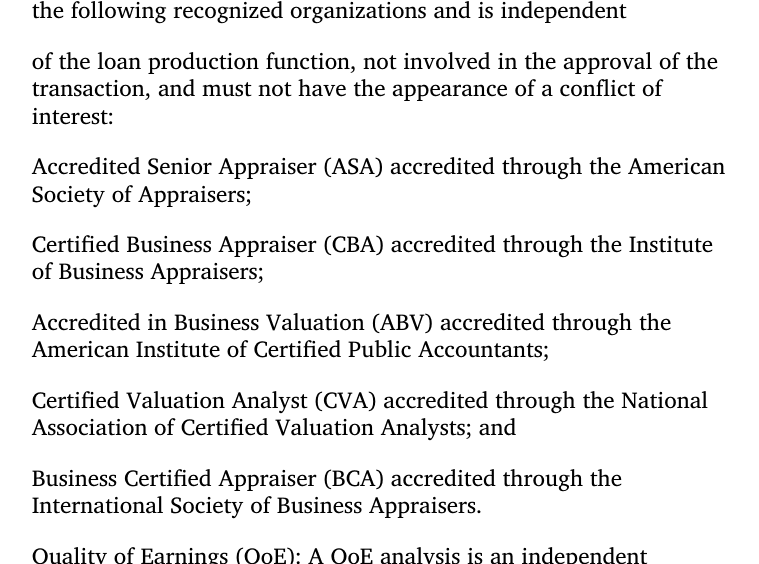
The valuation must come from a Qualified Source, a defined term meaning an individual who regularly receives compensation for business valuations and holds one of five accreditations: Accredited Senior Appraiser (ASA) from the American Society of Appraisers, Certified Business Appraiser (CBA) from the Institute of Business Appraisers, Accredited in Business Valuation (ABV) from the AICPA, Certified Valuation Analyst (CVA) from NACVA, or Business Certified Appraiser (BCA) from the International Society of Business Appraisers. They must also be independent of the lender's loan production function and free of any appearance of a conflict of interest.
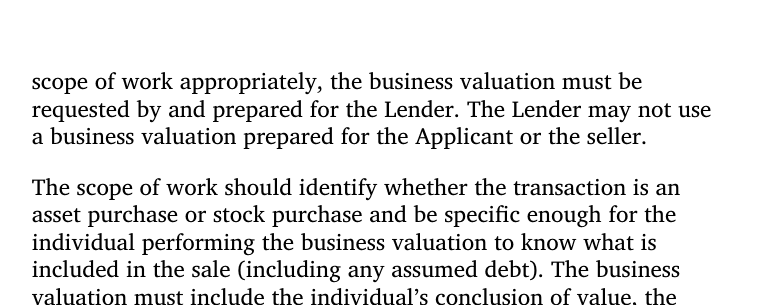
It must be commissioned by the lender, for the lender. The rule is explicit that the valuation must be requested by and prepared for the lender, and that the lender may not use one prepared for the applicant or the seller. A report you commission yourself does not become acceptable by being good. It is unusable because of who ordered it, and the same goes for a valuation the seller already paid for.
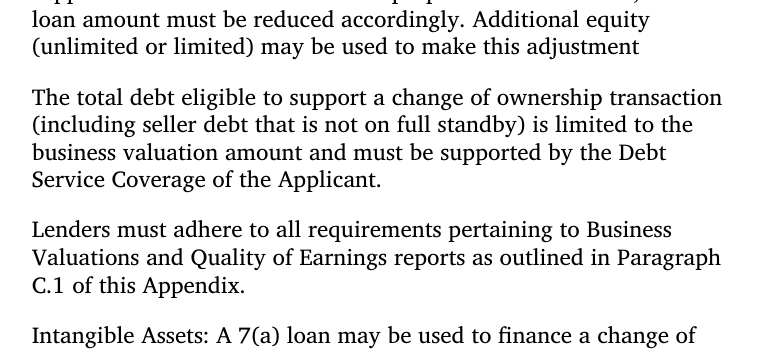
If the price beats the valuation, you cover the gap. The valuation has to support the purchase price regardless of how the debt is structured. Where the amount paid for the business exceeds the valuation, the difference must be made up by equity, which means your cash, not a bigger loan.
Your total debt is capped at the valuation. The total debt eligible to support a change of ownership transaction, including seller debt that is not on full standby, is limited to the business valuation amount. The appraiser's number is a ceiling on the entire capital stack, not just on the bank's piece.
The small-deal shortcut is going away
Under the version of SOP 50 10 in force today, a lender may perform its own internal valuation instead of hiring a Qualified Source where the amount being financed, less the appraised value of any real estate and equipment, is $250,000 or less, unless the lender's own policies say otherwise. That carve-out is why some buyers of very small businesses have never seen an independent appraisal.
SOP 50 10 8.1 takes effect on October 1, 2026. Its Appendix 15 states the valuation requirement with no dollar threshold attached and opens by requiring financial due diligence on all change of ownership transactions. On its face the small-deal shortcut will not survive, and buyers at the bottom of the size range should plan on a Qualified Source valuation being in the file. We track the full set of changes in our breakdown of SOP 50 10 8.1.
So what is the calculator good for
Used honestly, quite a lot. It is an offer-stage instrument, not a financing one.
| Online calculator | Qualified Source valuation | |
|---|---|---|
| Who it is for | You, at the offer stage | The lender, during underwriting |
| Cost | Free | A borrower expense, quoted per engagement |
| Turnaround | Seconds | Weeks, and it sits on the critical path |
| Inputs | What you type in | Financial statements verified against IRS transcripts |
| Multiple source | Usually undisclosed | Comparable transaction data the appraiser can defend |
| Output | A range | A signed conclusion of value with stated qualifications |
| Counts toward your loan file | No | Yes, and it caps your total debt |
Three jobs it does well:
Screening listings. Run the numbers from a broker's listing sheet before you sign a non-disclosure agreement. If the asking price implies a multiple far outside anything you can justify, you have saved a week.
Pressure-testing assumptions. Change one add-back and watch the valuation move. That sensitivity is the most useful thing a calculator teaches, because it shows which line items you will need to defend later.
Sizing the equity gap early. If your estimate of value lands below the asking price, you know roughly how much extra cash you may need beyond the standard equity injection, and you can raise it with the seller while there is room to move. Our SBA 7(a) loan calculator models the payment and coverage the loan would have to carry.
What it cannot do is predict your lender's appraiser, and when the two numbers differ the appraiser's is the one that sets your debt ceiling and your cash requirement.
Use the calculator before diligence, not instead of it
A valuation is only as good as the earnings underneath it, and the earnings a seller reports are not always the ones you will inherit. On larger deals SBA will require an independent quality of earnings report that reconstructs the cash and re-tests every add-back, and its normalized figure feeds straight into debt service coverage.
A calculator takes your inputs on faith. Diligence turns them into facts. Run the tool to decide whether a deal is worth diligence, then let diligence tell you what the business is worth.
Frequently asked questions
How do I calculate my business valuation?
Start with seller's discretionary earnings: net profit plus the owner's compensation, plus one-time and personal expenses run through the business. Then apply a multiple drawn from comparable sales in that industry and size band. The multiple is the hard part and the part worth sourcing carefully, because it drives the answer far more than any single add-back.
How much is a business worth with $500,000 in sales?
Revenue alone does not answer this. A $500,000 revenue business returning $180,000 to a working owner and one returning $40,000 have the same top line and very different values. Work out the discretionary earnings first, then apply a multiple. Revenue multiples are a fallback for businesses whose earnings are unreliable, not a primary method for a profitable owner-operated business.
Is a business worth 3 times profit? Or 5 times?
Both are rules of thumb, and which one applies depends on the industry, the size of the earnings, how much of the business walks out with the owner, and how concentrated the customer base is. Small owner-operated businesses generally trade at lower multiples than larger ones with management in place. Use a rule of thumb to sanity check an asking price, never to build an offer.
Will an SBA lender accept an online business valuation calculator?
No. SBA requires a business valuation from a Qualified Source, meaning an appraiser accredited as ASA, CBA, ABV, CVA, or BCA, and the report must be requested by and prepared for the lender. A valuation prepared for the buyer or the seller may not be used, which rules out anything you generate yourself.
What happens if the seller's price is higher than the valuation?
The valuation must support the purchase price regardless of how the deal is structured. If the price exceeds the valuation, the difference has to be covered by equity rather than by borrowing more. Separately, the total debt supporting the transaction, including seller debt that is not on full standby, is capped at the valuation amount.
Who pays for the SBA business valuation?
The out-of-pocket cost of required financial due diligence can be passed on to the borrower, and amounts you spend on it count toward your required equity injection. Confirm the specifics with your lender, since fees and scope vary by engagement.
This article is process documentation and education, not financial, legal, or tax advice. Rules are cited from SBA's SOP 50 10 and the change of ownership regulation, and your transaction will turn on its own facts, so confirm anything that affects your deal with your lender, your attorney, and your CPA.