
A quality of earnings report is an independent financial study that tests whether a business's reported earnings are real, recurring, and likely to continue after a sale. Buyers commission one during due diligence, before committing to a price. From October 1, 2026, SBA will require one on any 7(a) business purchase priced at $3 million or above.
That last point is new, and it is the reason this page exists. Every other guide to quality of earnings reports is published by a firm that sells them, and none has yet accounted for a rule that converts the report from a prudent option into a condition of financing for a whole segment of deals.
What a quality of earnings report actually tests
A seller hands you financial statements. The question a QoE answers is not whether those statements add up, but whether the earnings they show are the earnings you will inherit.
The work runs along three lines. Are the numbers accurate, meaning do the internal statements reconcile to the tax returns and to what actually moved through the bank. Are they normal, meaning what happens once you strip out one-time events and adjust for an owner who paid themselves oddly or ran personal costs through the business. And are they durable, meaning does the revenue survive the owner leaving, or is a third of it one customer who golfs with the seller.
The output is a normalized earnings figure, usually an adjusted EBITDA, along with a documented list of every adjustment made to get there and an assessment of the risks sitting behind the number.
A QoE is not an audit
These get conflated constantly, and they answer different questions.
| Quality of earnings report | Audit | |
|---|---|---|
| Core question | Are these earnings real and repeatable? | Do these statements comply with accounting standards? |
| Looks | Forward, at sustainability | Backward, at accuracy of a completed period |
| Governed by | The engagement scope agreed with whoever commissions it | Formal auditing standards |
| Produces | Normalized earnings and a risk assessment | An opinion on the financial statements |
| Typical trigger | A pending transaction | A lender covenant, investor, or regulator |
An audit can come back clean while the earnings remain low quality. A business can be perfectly compliant and still depend on one contract that expires next year. The QoE exists to surface exactly that.
Buy-side, sell-side, and who pays
A buy-side report is commissioned by the buyer to test the seller's numbers before closing. A sell-side report is commissioned by the seller before going to market, to find problems early and defend the asking price.
Ordinarily whoever commissions it pays for it, and the report belongs to them. In an SBA deal that flexibility disappears, which is covered below.
The rule taking effect October 1, 2026
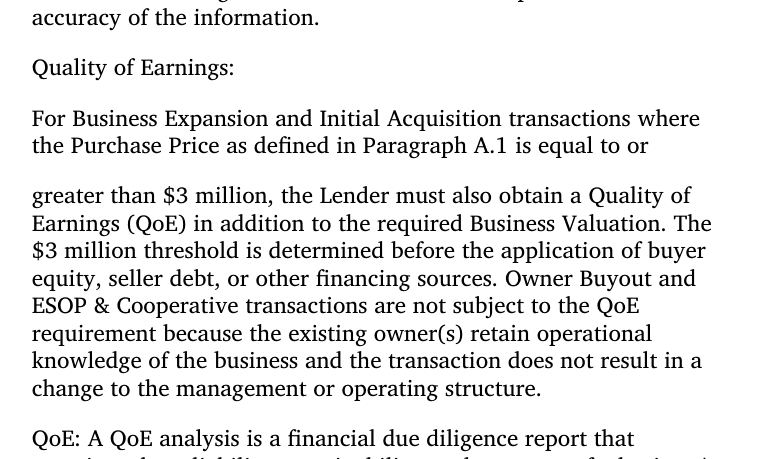
SBA's revised loan origination rulebook, SOP 50 10 8.1, introduces a mandatory QoE requirement. The relevant facts for a buyer:
- It applies to Initial Acquisition and Business Expansion transactions where the business purchase price is at or above $3 million.
- The threshold is measured before any buyer equity, seller debt, or other financing is applied, so structuring the deal cannot get you under it.
- Owner Buyout and ESOP or cooperative transactions are exempt, on the reasoning that the existing owners already hold operational knowledge of the business.
- The QoE is required in addition to the business valuation, not instead of it.
There is a detail here worth pausing on, because it changes who is affected. SBA's threshold is set on purchase price. Providers price their work off EBITDA. A business selling for $3 million typically earns well under $3 million, so the deals newly captured by this rule sit at the smaller end of the market, where a formal QoE was previously uncommon. If you are buying a business at a $3M to $5M price, you are the segment this rule just reached.
What SBA specifically requires the report to contain
This is where the SBA version diverges from a general market QoE, and it is more prescriptive than most buyers expect.
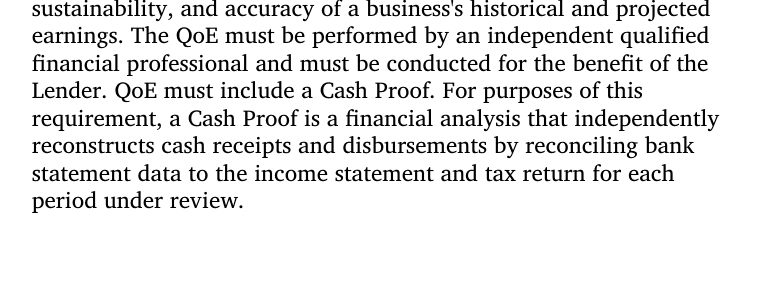
It must be for the lender. The report must be conducted for the benefit of the lender and may not be prepared by or for the borrower or the seller. A sell-side report the seller already paid for does not satisfy the requirement, and neither does one you commissioned for yourself before your lender was involved. Commission it through the lender.
It must be performed by an independent, experienced financial professional.
It must reconcile everything. The analysis has to tie together the accountant-prepared financial statements, the tax returns, the internal financial statements, and the IRS transcript data, producing a normalized adjusted earnings figure that reflects recurring, arm's-length operations.
It must include a Cash Proof. This is the most demanding element and the one least familiar to buyers. A Cash Proof reconstructs cash receipts and disbursements by reconciling bank statement data against the income statement and the tax return for each period under review. Its purpose is to catch income that was never reported and expenses that were never disclosed. It must be performed on both a trailing twelve month basis and for the last two fiscal years.
It must document every adjustment, including non-recurring revenue and expenses, above or below market owner compensation, related-party transactions, deferred maintenance, and differences between cash-basis and accrual reporting.
It must assess durability, covering customer concentration risk, contract continuity, and the likelihood that existing revenue and margins hold after the sale.
The consequence buyers should plan for
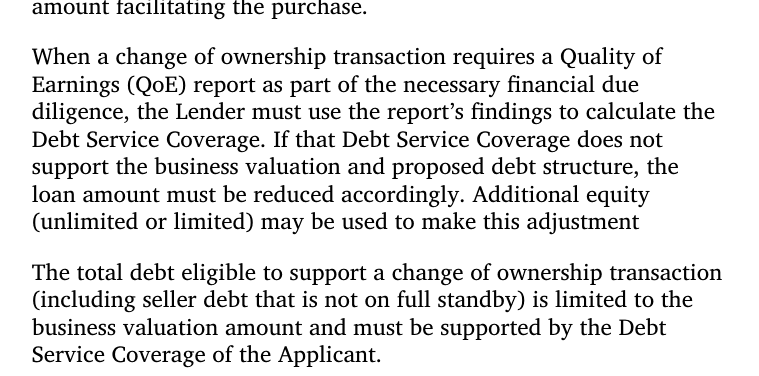
A QoE in an SBA deal is not a document that gets filed and forgotten. The lender must use the earnings it produces in the debt service coverage calculation, and if that coverage does not support the business valuation and the proposed debt structure, the loan amount must be reduced.
Read that in sequence. You agree a price. The QoE normalizes earnings downward, as it often does when a seller has been generous with add-backs. Coverage no longer works at the loan amount you needed. The loan shrinks, and the difference lands on you, either as additional equity or as a renegotiation with a seller who has already anchored on the original number. Before you get there, you can test how much headroom a deal has with our DSCR calculator.
This is why the report should be commissioned early rather than late. Discovering a gap while there is still time to reprice is a different situation from discovering it two weeks before closing.
What it costs
Costs vary widely with deal size and complexity, and the published figures come from the providers themselves rather than any independent survey, so treat them as a starting point for quotes rather than a benchmark.
Provider pricing published during 2026, for example Bedrock's cost breakdown, puts a report for a smaller transaction in the range of roughly $5,000 to $20,000, with the broader market spanning $5,000 to $50,000 and above as deals get larger. Turnaround is commonly two to three weeks, and rush work carries a premium.
Quality of earnings report cost, by deal size
- Low
- High
Provider list pricing published 2026, not an independent survey. SBA's mandate threshold is set on purchase price, not EBITDA.
Show data table
| Business size | Low | High |
|---|---|---|
| Smaller deals | 5,000 | 20,000 |
| Under $3M EBITDA | 15,000 | 25,000 |
| $3M to $10M EBITDA | 25,000 | 50,000 |
| Above $10M EBITDA | 50,000 | 75,000 |
Two SBA-specific points make the cost more bearable than it first appears. The out-of-pocket costs of required financial due diligence, including the QoE and the business valuation, may be passed on to the borrower, and those amounts count toward your required equity injection. Money you spend proving the numbers is not money spent on top of your down payment. It is part of it. What else counts toward the injection, and what does not, is what our equity injection checker is for.
Frequently asked questions
How much should a quality of earnings report cost?
Provider pricing published in 2026 puts smaller transactions in the region of $5,000 to $20,000, rising well beyond that as deal size grows, with a premium for rush turnaround. These are vendor list figures rather than an independent survey, so gather quotes. On an SBA deal, remember the cost counts toward your required equity injection.
What is the difference between a quality of earnings report and an audit?
An audit asks whether financial statements comply with accounting standards for a completed period. A QoE asks whether the earnings are real, normal, and likely to continue after a sale. A business can pass an audit cleanly and still have low quality earnings, for example where a third of revenue depends on a single customer relationship.
Who pays for a quality of earnings report?
Normally whoever commissions it, and the report belongs to them. In an SBA-financed acquisition the report must be conducted for the benefit of the lender and may not be prepared by or for the borrower or seller, though the out-of-pocket cost can be passed to the borrower and counts toward the required equity injection.
Does my SBA deal need a quality of earnings report?
From October 1, 2026, yes if it is an Initial Acquisition or Business Expansion with a purchase price at or above $3 million, measured before any equity, seller debt, or other financing. Owner Buyout and ESOP or cooperative transactions are exempt.
Can I use the seller's quality of earnings report?
Not to satisfy the SBA requirement. The report must be conducted for the benefit of the lender and may not be prepared by or for the seller. A sell-side report is still useful context during negotiation, but it does not replace the one your lender needs.
Where this sits in the deal
A QoE is one of two independent financial checks on an SBA acquisition, alongside the business valuation, and the two do different jobs: the valuation tests the price, the QoE tests the earnings the price was based on. Our breakdown of the rules taking effect October 1 covers both, along with the debt service coverage change that determines what the QoE's output has to support. For the financing path end to end, from eligibility through closing, see our guide to an SBA loan to buy a business.
This article is process documentation, not financial, legal, or tax advice. Requirements are cited from SBA's SOP 50 10 8.1 and your transaction will turn on its own facts, so confirm scope and timing with your lender and your accountant.