
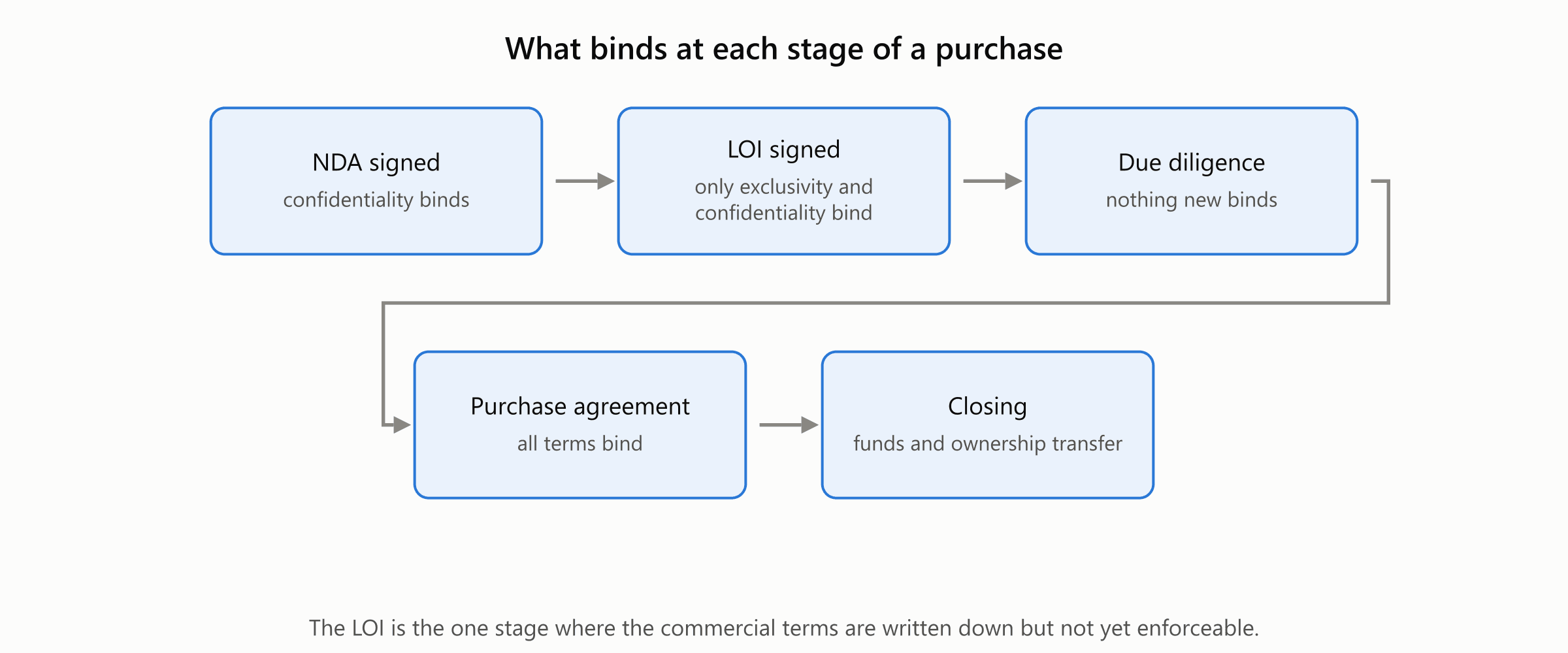
A letter of intent to buy a business is mostly not a contract. In a typical LOI only two provisions actually bind: confidentiality and exclusivity. Price, structure, terms, and the closing date are statements of present intention that either side can walk away from. Most buyers learn this and draw the wrong conclusion from it, keeping the document short on the theory that anything written down is a commitment. The opposite is true. Because the commercial terms do not bind, every condition you state is a tripwire rather than a promise: a specific thing you get to test during due diligence and reprice against, without having agreed to anything. The buyers who lose leverage are the ones who wrote two pages.
What a letter of intent to buy a business actually does
A letter of intent, or LOI, is a written summary of the deal both sides believe they are doing, signed before anyone spends real money on lawyers and accountants. It sets the price, the structure, the diligence window, and the conditions that have to be true at closing. It then hands the parties a period of exclusivity in which to find out whether any of it survives contact with the books.
It gets signed at a specific moment: after you have seen enough financial information to name a number, and before you commit to the cost of confirming it. That sequencing is the point. A quality of earnings study, a lender's business valuation, an environmental review and a lease assignment all cost money, and no buyer will spend it while the seller is still taking calls from other buyers.
The benefits are narrow and worth naming plainly. You get exclusivity. You surface the deal-breakers now rather than in week nine. You give your lender something to underwrite against. And you find out, cheaply, whether the seller's understanding of the deal matches yours, which is more often false than buyers expect.
Which parts of an LOI actually bind you
Read any LOI you are handed and sort it into two piles. Almost everything lands in the non-binding pile, and that is by design: an LOI that bound the price would be a purchase agreement written by someone who had not done diligence.
| Provision | Usually binding? | Why |
|---|---|---|
| Confidentiality | Yes | Often restates or incorporates the non-disclosure agreement you already signed. Survives termination. |
| Exclusivity (no-shop) | Yes | The consideration the seller gives for your diligence spend. Enforceable and time-limited. |
| Expenses | Yes | Each side bears its own costs unless stated otherwise. Cheap to include, prevents an argument. |
| Governing law and dispute forum | Yes | Applies to the clauses that do bind. |
| Purchase price | No | A statement of present intention, subject to diligence and financing. |
| Deal structure (asset purchase or stock sale) | No | Frequently changes once tax advice lands. |
| Closing conditions and assumptions | No | These are tests, not promises. The core of your leverage. |
| Target closing date | No | Nobody controls a lender's underwriting queue. |
Two clauses deserve a note. First, put an explicit statement in the document naming which paragraphs bind and stating that no other paragraph creates an obligation to complete the transaction. Without it you are relying on a court to infer intent from a document whose title says the opposite. Second, be careful with an obligation to negotiate in good faith. It sounds harmless and it is genuinely binding in several states, which means a buyer who walks away for a reason unrelated to diligence has created an argument. Say that either party may terminate for any reason or no reason, and say it in the same paragraph.
An earnest money deposit is a separate question. If you include one, put it in escrow with a third party, state exactly what triggers its return, and keep it small. A deposit that is refundable on any diligence finding is a signal of seriousness that costs you nothing. A deposit that is only refundable if financing fails hands the seller a fee for your time.
Non-binding is the reason to load the document, not shorten it
Here is the mechanism the template farms never explain.
Every assumption you state in the LOI becomes a condition you may test. If the assumption turns out to be true, nothing happens and you have lost nothing by writing it down. If it turns out to be false, you have a written, seller-acknowledged basis for repricing or walking, and you did not have to argue about whether it mattered. You already agreed it mattered, on the day the seller signed.
The reverse is what actually costs buyers money. An assumption you did not write down is a discovery you have to fight about. Six weeks into diligence you find that a machine the business depends on is leased rather than owned, and the lease expires the year after you close. Without a stated assumption you are the buyer with cold feet trying to renegotiate. With one you are the buyer enforcing a condition the seller agreed to in writing before you spent a dollar.
So the correct instinct is to load the assumptions section, not to trim it. The cost of an extra assumption is a paragraph. The cost of a missing one is the entire negotiating position on whatever it would have covered.
There is a limit, and it is a real one. Assumptions must be things you could plausibly verify, stated in terms the seller can accept without feeling attacked. A list of forty conditions written in the register of a lawsuit reads as bad faith and gets the LOI rejected. Ten to fifteen precise, verifiable, neutrally worded conditions read as a buyer who has done this before.
How to write a letter of intent, section by section
Step 1
Name the parties precisely
Identify the buyer and seller as legal entities, not as people, and say which entity is actually signing. If you intend to acquire through a newly formed company that does not exist yet, say so and name yourself as the party who will assign the LOI to it. Sellers who discover this at purchase agreement stage treat it as a surprise, and it is avoidable in one sentence.
Step 2
Describe the business and what is included
Name the business, its legal entity, and its location. Then describe the assets: equipment, inventory, contracts, customer lists, intellectual property, goodwill, and any real estate. Be equally clear about what is excluded, because the exclusions are where sellers keep personal vehicles, life insurance policies and the odd piece of equipment. State that all assets transfer free and clear of liens and encumbrances.
Step 3
Choose the structure and say what you will accept
State whether you are proposing an asset purchase or a stock sale. Buyers generally want an asset purchase for the liability shield and the tax step-up in basis on the acquired assets; sellers generally prefer a stock sale for capital gains treatment and to hand over the liabilities with the keys. Say which you are proposing and add that the parties will cooperate on a structure that preserves your intended tax treatment. If non-transferable licences or contracts force a stock sale, you want to have flagged the tax consequence before you priced it.
Step 4
State the price as total transaction value first
Lead the paragraph with the total value of the transaction, then break it into its components: cash at closing, financed amount, any seller note, any holdback. Sellers read the first number in the paragraph as the offer, so a paragraph that opens with your equity contribution has anchored the negotiation on the smallest figure in the deal. Say what the price assumes about working capital and debt, and say that it is subject to the assumptions listed below.
Step 5
Write the assumptions as testable conditions
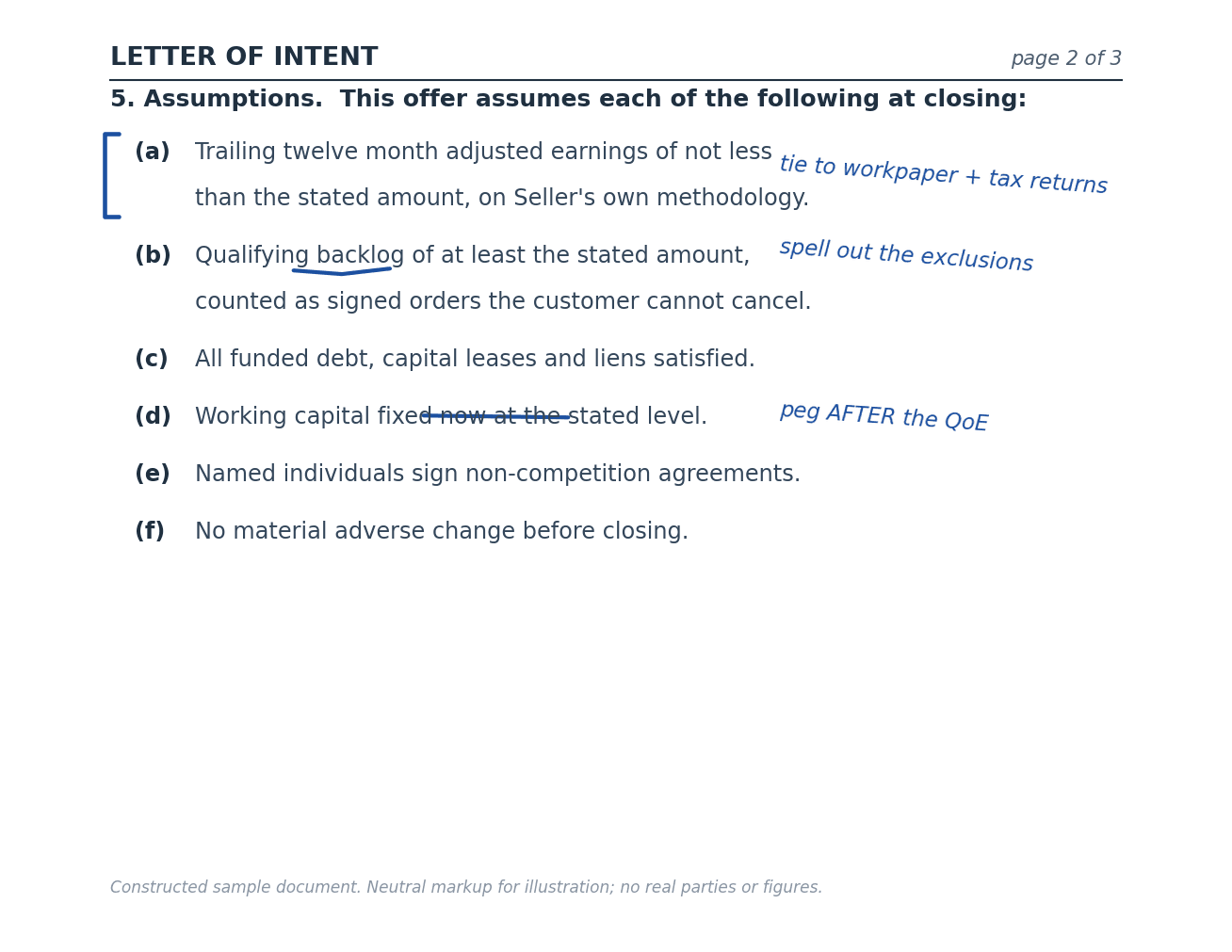
This is the longest section and the one that earns its length. Each assumption should name a thing, a threshold, and a method of measurement. 'The business is performing well' is not an assumption. 'Trailing twelve month adjusted earnings of at least the amount shown on the seller's workpaper dated as provided, computed on the same methodology' is. The detail below covers which ones matter.
Step 6
Set the diligence scope and the access you need
State what you will review: financial statements, tax returns, bank statements, contracts, leases, employee records, insurance, litigation history and permits. State that you may engage third parties including an accountant performing a quality of earnings analysis. State that access includes the ability to speak with named management, and address customer and employee contact explicitly, because sellers reasonably want to control when staff learn the business is for sale. Agreeing that sequence now prevents a stand-off later.
Step 7
Set exclusivity, and make it long enough to be real
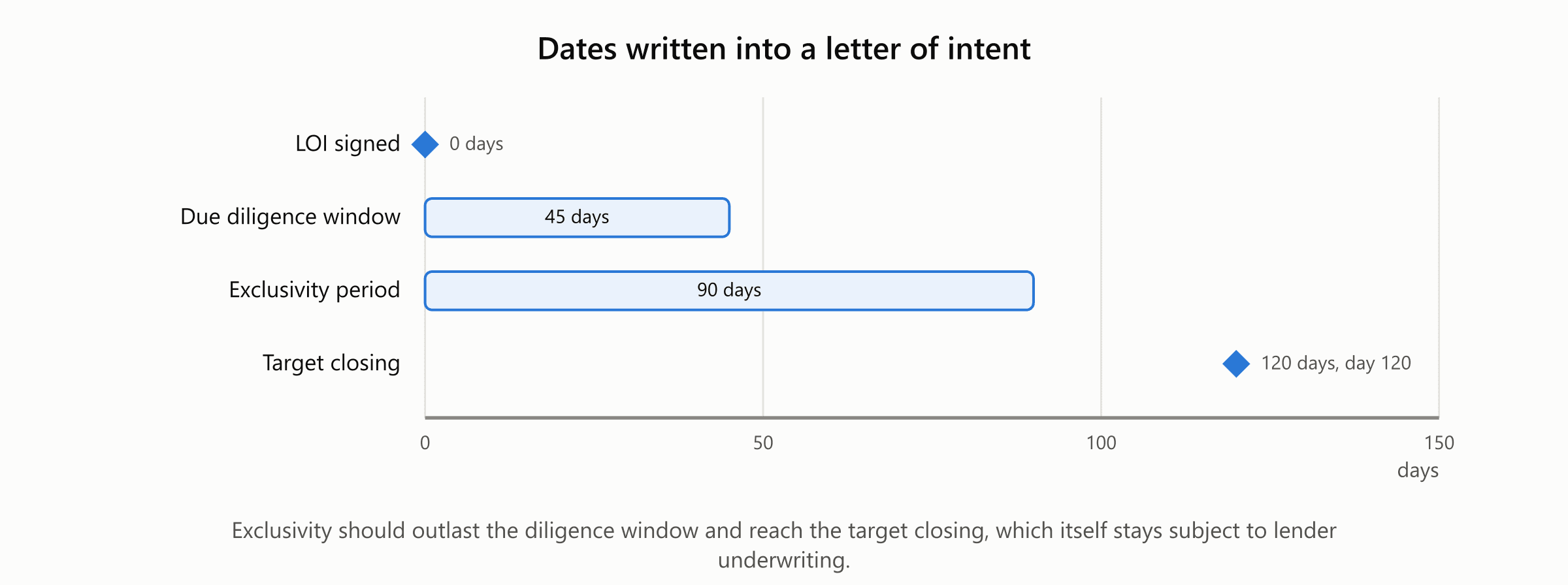
Exclusivity is one of the two clauses that binds, so write it properly. The seller agrees not to solicit, negotiate with, or provide information to any other prospective buyer for a defined period, and agrees to notify you if approached. Make the period long enough to complete diligence and get through underwriting, because a period that expires mid-underwriting hands the seller a free look at the market at the worst possible moment for you.
Step 8
State the closing conditions and the timeline honestly
List what has to be true to close: satisfactory diligence, financing on terms acceptable to you, an assignable or renegotiated lease, third party consents, key employee retention, and a signed purchase agreement. Write the timeline as a target rather than a commitment: 'targeting closing within 120 days of signing, subject to lender underwriting' is accurate and defensible. A bare date you miss is a credibility loss you handed yourself for nothing.
Step 9
Set an expiration date on the offer itself
Say when the offer lapses if unsigned. This is a small clause with an outsized effect on tone. A one day fuse reads as a pressure tactic and gets you treated as a tourist. Roughly a week reads as a buyer with other options and a functioning calendar. Then add the signature blocks, and remember that everything above the binding-provisions paragraph is still just intent.
Anchor the price paragraph on the total, not on your equity
A financed acquisition has two numbers in it, and they are far apart. There is the total transaction value, which is what the seller receives. And there is your equity contribution, which is what leaves your account. Buyers who are nervous about the size of the deal instinctively open the price paragraph with the second number, because it is the one they have been staring at for weeks.
That is an anchoring mistake, and it is expensive. The seller reads the first figure in the paragraph as the offer. Lead with the total, then itemise: cash at closing, the financed portion, any seller note, any holdback. The components tell the seller how they get paid. The total tells them what they are being paid.
The same discipline applies to the timeline sentence. "Closing on or before November 14" is a date you do not control, because a lender's underwriting queue is not yours to schedule. "Targeting closing within 120 days of signing, subject to lender underwriting" says the same thing without handing the seller a missed commitment to raise in week fourteen.
Two numbers a buyer could lead with
Illustrative teaching figures, not a real transaction.
Show data table
| Amount | |
|---|---|
| Total transaction value | 1,850,000 |
| Buyer equity contribution | 185,000 |
The assumptions worth loading
Not all assumptions are equal. These are the ones that repeatedly turn out to matter, and the specific wording that makes each one work.
Minimum earnings, measured on the seller's own methodology. This is the single most important sentence in the document and the one buyers most often get wrong. The instinct is to write "assumes at least $X of adjusted EBITDA." The problem is that if the seller's own workpapers compute seller's discretionary earnings rather than EBITDA, you have just introduced a metric they never used, and the first thing that happens when you try to enforce the condition is a definitions fight you cannot win. Instead, tie the threshold to the seller's own workpaper, by date, computed on the same methodology. You are not asking them to agree to a new standard. You are asking them to stand behind the arithmetic they already handed you.
Debt-free and lien-free delivery. All funded debt, capital leases, accrued taxes and liens are satisfied at or before closing from seller proceeds. Short, standard, and the absence of it is expensive.
Adequate working capital at closing. State that the business will be delivered with working capital sufficient to operate it in the ordinary course, and that the parties will set the peg after diligence. Note the deliberate vagueness on the number, covered below.
Tax treatment. State the structure you expect and that the parties will cooperate on a purchase price allocation consistent with it. If you are buying assets you want the step-up; if the seller later insists on an allocation that guts it, you want to have raised this before the price was fixed.
Lease terms. If the business occupies premises the seller owns personally, this is a negotiation, not a formality, and it is covered in detail below.
Non-competes. Name who signs one, the duration and the geographic scope. If a key employee is the actual relationship holder with your largest customers, name them too.
Transition support. State how long the seller will remain available and in what capacity. If you are financing with an SBA loan, the capacity matters enormously, and the rules are covered further down.
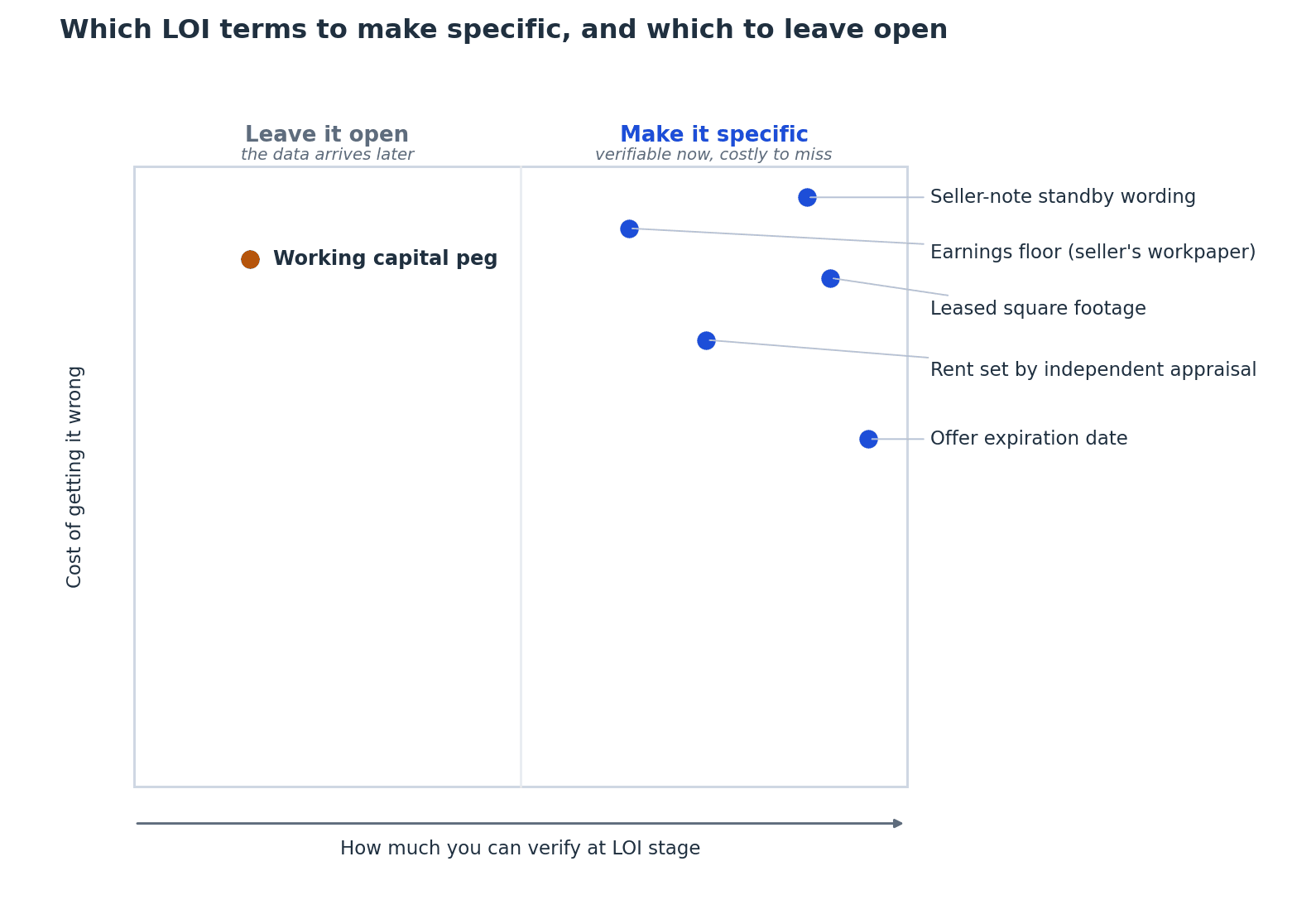
Where vagueness genuinely helps
The principle is simple: do not commit to a number before you have the data that would let you defend it.
Net working capital by month
Illustrative teaching figures, not a real transaction.
Show data table
| Month | Net working capital |
|---|---|
| Jan | 242,000 |
| Feb | 231,000 |
| Mar | 268,000 |
| Apr | 255,000 |
| May | 274,000 |
| Jun | 249,000 |
The net working capital peg. The peg is the level of working capital the business must be delivered with, and it drives a dollar for dollar price adjustment at closing. Setting it in the LOI means setting it from the seller's internal statements, before anyone has tested whether receivables are collectible or whether the payables balance is complete. Say the peg will be established after the quality of earnings analysis, based on a trailing twelve month average computed on the normalized figures. That sentence is not weakness. It is the only version of the clause you can actually enforce.
Where vagueness costs you
The mirror image. These are cheap to state precisely now and expensive to leave loose.
Leased square footage. If the seller owns the building personally, they are about to become your landlord, and the lease is a second negotiation conducted with a counterparty who knows your loan depends on it. Name the square footage. A lease that says "the premises" lets a seller lease you the warehouse and keep the yard.

A rent tied to independent appraisal. Do not accept a number. State that rent will be set at fair market value as determined by an independent appraisal, with terms satisfactory to your lender. That last phrase does real work, because your lender will have its own view on lease term relative to loan term, and you would rather discover that now than the week before closing.
A right of first refusal on any future sale of the building. One sentence. If the business depends on the location, you do not want to learn the building sold to a third party who has other plans for it.
The seller note's compliance language. If SBA financing is involved, generic seller note wording will not survive underwriting. Details below.
The expiration date on your offer. A specific date, roughly a week out.
Mechanisms beat discounts
Most buyers respond to risk by asking for a lower price. It is the wrong instrument, because it asks the seller to pay for a problem that may not exist, and sellers reject it on exactly that basis.
A mechanism charges the seller only if the risk turns out to be real. It costs them nothing if their numbers were honest, which is precisely the argument that gets it accepted.
Here is an illustrative worked example. Every figure below is invented for teaching purposes and does not describe any actual transaction.
Suppose the seller books $600,000 of accounts receivable and treats every dollar as collectible. Asking for a $60,000 price cut gets you a fight about whether the receivables are good. Instead, write the assumption and attach a measurement: any receivable not collected within ninety days of closing is charged back to the seller, dollar for dollar.
Now run it. Ninety days after closing, $150,000 of the $600,000 is still outstanding, most of it from accounts that were already past due when you signed. The seller refunds $150,000. No argument, no renegotiation, no cold-feet accusation. And if every invoice had collected, the seller would have paid nothing, which is why they agreed to it.
The same pattern applies to the working capital peg set after the quality of earnings work, and to any condition where you suspect a problem but cannot yet size it.
Receivables booked at closing versus collected within 90 days
Illustrative teaching figures, not a real transaction.
Show data table
| Receivables | |
|---|---|
| Booked at closing | 600,000 |
| Collected within 90 days | 450,000 |
What changes when an SBA 7(a) loan is funding the purchase
If a bank is lending against the business itself, the LOI is no longer only a negotiation with the seller. It is also a first draft of something an underwriter will read. Several structures that a seller will happily agree to are unusable, and the LOI is the cheapest place to find that out.
The rules below are from SBA's loan origination handbook, SOP 50 10 8.1, whose Appendix 15 governs change of ownership transactions and takes effect October 1, 2026. The underlying authority permitting a 7(a) loan to fund an acquisition is 13 CFR 120.202.
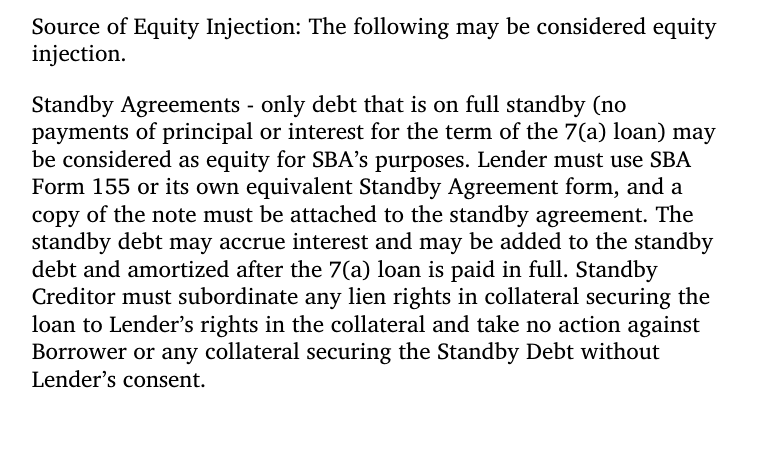
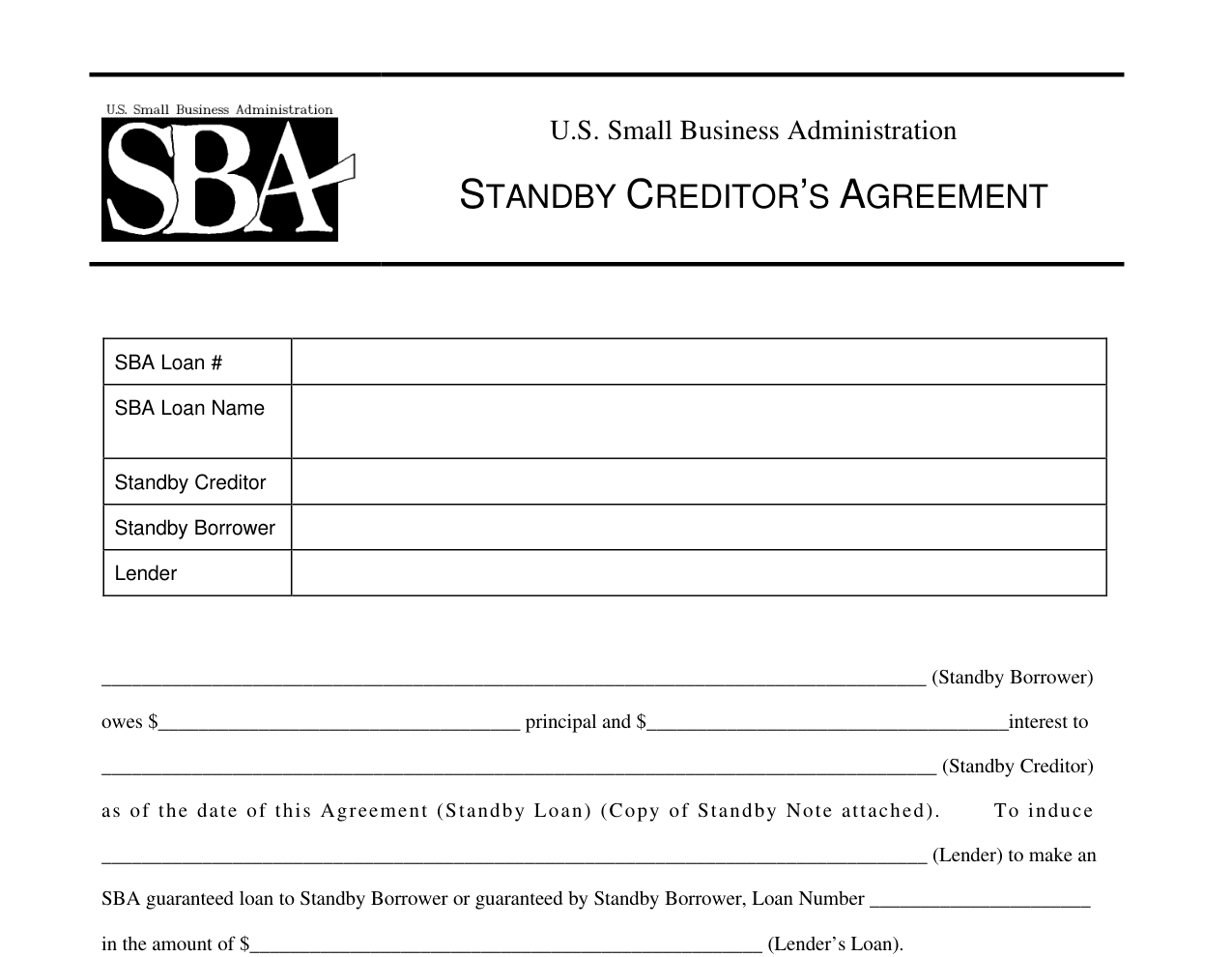
A seller note only counts as equity if it is on full standby. Full standby has a precise meaning: no payments of principal or interest for the term of the 7(a) loan. Not interest-only. Not deferred for two years. A note whose maturity falls inside the SBA loan term is by definition not on full standby, so it counts for nothing toward your required equity injection, and it still adds to the debt the deal has to service. Buyers negotiate a five year seller note against a ten year loan, believing it covers half their down payment, and discover in underwriting that it covers none of it. Standby is documented on SBA Form 155, the Standby Creditor's Agreement, or a lender equivalent, with a copy of the note attached.
A standby note can cover at most half of the injection. Seller debt on full standby sits in the limited equity sources category, and those sources, individually or in aggregate, may provide no more than half of the required equity injection. The rest has to be unborrowed cash or a personal loan you can demonstrably repay from something other than the business.
The injection is computed on total project cost, not purchase price. The requirement is based on the total project cost of the business plus any additional use of proceeds included in the loan request. Closing costs, working capital and fees are inside that base. A buyer who sized their cash against the purchase price alone will be short.
An initial acquisition's injection cannot be reduced. The minimum for a change of ownership is ten percent, and for an initial acquisition, meaning a buyer who does not already own a similar business, lenders have no discretion to reduce or waive it.
Standby debt has no early refinance exit. A seller note is eligible for refinancing once it has been in place and current, and the handbook adds the operative parenthetical, "(not on standby)," for at least 36 months following the change of ownership. Carry that parenthetical, because it is the whole qualifier. Time spent on standby does not count toward the clock. Version 8 of the handbook set that period at 24 months, so from October the wait gets longer.
The seller cannot stay on as an employee. In an initial acquisition or business expansion, the seller may not remain an officer, director, stockholder or employee of the business. A transition period is permitted only as a consulting contract, capped at 24 months in aggregate including any extensions. If your LOI promises the seller a two year employment agreement, it promises something the loan cannot accommodate.
Earnouts are prohibited. Seller earnouts are not permitted in these transactions. Buyer rebates based on business performance are allowed, because the benefit runs to the borrower, and any rebate received must be applied to the principal balance of the loan. If you want performance-contingent economics, that asymmetry is the shape they have to take.
Diligence you may not have budgeted for. A business valuation from an accredited qualified source is required, prepared for the lender rather than for you. From October 1, 2026, an initial acquisition or business expansion with a purchase price at or above $3 million also requires a quality of earnings report, measured before any buyer equity or seller debt is applied. There is a consolation: out-of-pocket costs for required financial due diligence can be passed to the borrower and count toward the equity injection.
One consequence ties back to the price paragraph. Total debt supporting the transaction, including seller debt not on full standby, is limited to the business valuation amount. If the valuation comes in below your agreed price, the gap becomes equity, which is another reason the LOI should treat the price as contingent on a valuation nobody has commissioned yet.
What an LOI cannot do for you
It cannot make anyone sell. Outside the exclusivity and confidentiality clauses, either party can walk, and a seller who receives a better offer during the exclusivity period can simply wait it out and take the other deal on the day it expires. The remedy for a breach is usually your costs, not the business.
It cannot substitute for diligence. Every assumption you write is a test you still have to run. An LOI full of conditions nobody verifies is a document that made you feel prepared.
It cannot fix a price you have not justified. If you have not worked out how to value the business before you sign, the number in the LOI is an anchor you set against yourself.
And it can hurt you if you are careless with the binding clauses. An exclusivity period that is too short, a good faith negotiation obligation with no termination right beside it, or a non-refundable deposit are the three ways a non-binding document turns into a real liability.
Frequently asked questions
What is a letter of intent to acquire a business?
A written summary of the deal both parties believe they are doing, signed before diligence begins. It covers price, structure, assumptions, the diligence window and the target closing date. Almost all of it is non-binding: typically only confidentiality and exclusivity create enforceable obligations, along with housekeeping clauses on expenses and governing law.
How do I write a letter of intent to purchase a business?
Name the parties as legal entities, describe the business and exactly which assets are included and excluded, state whether you are proposing an asset purchase or a stock sale, lead the price paragraph with total transaction value, then write a loaded assumptions section where each condition names a thing, a threshold and a measurement method. Add diligence scope, an exclusivity period long enough to survive underwriting, closing conditions, a target timeline phrased as a target, an expiration date on the offer, and an explicit paragraph naming which provisions bind.
Can a seller back out of an LOI?
Generally yes. Outside the binding provisions there is no obligation to complete the transaction, so a seller can end negotiations. What they cannot usually do is negotiate with another buyer during the exclusivity period or disclose your confidential information. The practical remedy for breaching those clauses is your out-of-pocket costs, which is a reason to keep diligence spend proportionate until the purchase agreement is in draft.
What are the risks of signing an LOI?
Three that matter. An exclusivity period too short to cover underwriting, which lets the seller re-open the market at the worst moment. A good faith negotiation obligation with no matching right to terminate for any reason, which can convert walking away into a dispute. And a deposit that is not fully refundable on diligence findings. The price itself is a smaller risk than buyers assume, because it does not bind.
Should the LOI be binding or non-binding?
Non-binding on the commercial terms, binding on confidentiality, exclusivity, expenses and governing law, and explicit about which is which. A binding LOI is a purchase agreement negotiated before diligence, which means agreeing a price using the seller's numbers and no independent verification.
How long should the exclusivity period be?
Long enough to complete diligence and clear lender underwriting, with margin. Financed deals fail this test most often, because buyers size the period against their diligence plan and forget that underwriting runs after diligence, not alongside it. If the period is going to expire before closing, negotiate an extension mechanism into the clause rather than relying on goodwill later.
Before you sign
The document you want is longer than the free templates and shorter than a purchase agreement. It states the price as total transaction value, sets a target timeline rather than a promise, leaves the working capital peg open for data you do not have yet, and spends most of its length on precise, testable assumptions that cost nothing if the seller was telling the truth.
If financing is the constraint, start with how the equity injection rules work and how seller notes are treated, because both change what you can put in the price paragraph. And build your due diligence checklist from your own assumptions section, so every condition you wrote has someone assigned to test it.
This article is process documentation and education, not legal, financial or tax advice. A letter of intent contains provisions that are legally binding on you, and the wording of those provisions varies by state. Have your own attorney review any LOI before you sign it.