
Most guides on how to buy a business hand you a list of stages: find a target, value it, run diligence, close. That list is not wrong, and it is also not the part anyone gets wrong. What buyers get wrong is timing. They retain an attorney after the letter of intent is already drafted. They meet a CPA at closing, when the entity structure is long since fixed. They find out whether a deal is bankable after they have already committed to a price in writing. This guide sequences the process by when each professional enters, because that ordering decides how well everything downstream goes.
The sequence below is a generic template, not a diary of any particular transaction. Elapsed times are given as ranges because the second half of an acquisition runs on someone else's clock.
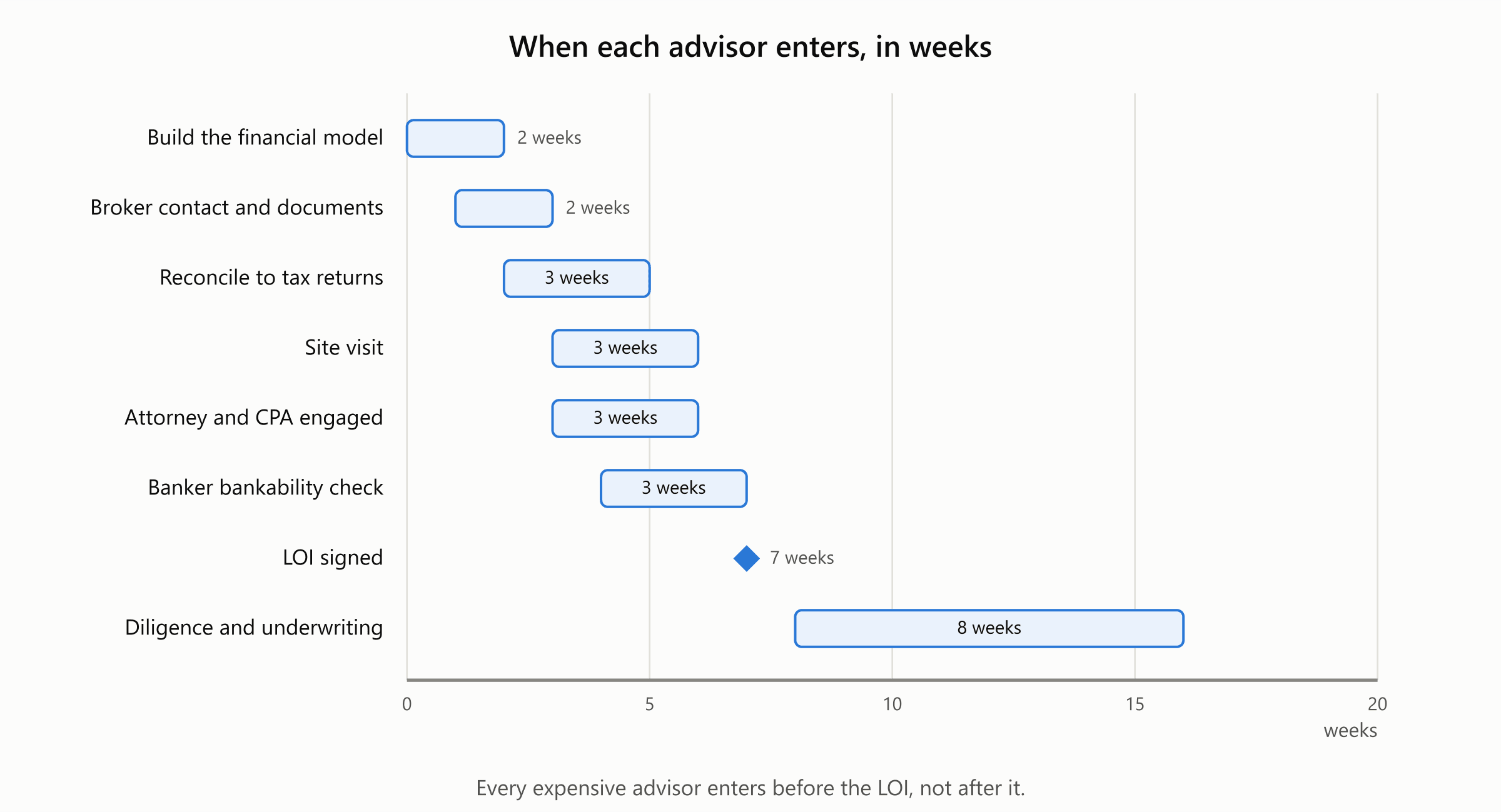
When each advisor enters, and what waiting costs you
Every professional in an acquisition has a moment when their input is cheap and decisive, and a later moment when the same input is expensive and mostly cosmetic.
| Advisor | Bring them in | What it costs you if you wait |
|---|---|---|
| CPA and tax counsel | Before the LOI, while you are still modeling the deal | Entity structure and the asset versus stock question get settled by default instead of by design. A tax step-up you could have negotiated for free is simply gone. |
| Attorney | Pre-engagement, on a redacted brief, before anyone drafts the LOI | You negotiate the terms that matter most inside the document that binds least, with nobody who has seen the shape of the deal before. |
| Lender or banker | Before the LOI is signed, to confirm bankability | You commit to a price the cash flow cannot carry, then discover it in underwriting after weeks of spend and a dead exclusivity window. |
| Quality of earnings firm | After the LOI, selected together with your banker | You pay for a report your lender will not use, because the lender's credit memo has to consume it and it has to be prepared for them. |
| Business appraiser | During underwriting, commissioned by the lender | A valuation you ordered yourself cannot be used at all in an SBA-financed deal, so you pay twice and restart the clock. |
| Business broker | At first contact, but understood as the seller's agent and never yours | You mistake helpfulness for representation, and negotiate against a professional while believing you have one. |
The step by step process
Step 1
Build a financial model with adjustable levers, before any price conversation
Not a spreadsheet of one deal at one price. A model where purchase price, down payment, interest rate, seller note size, and earnings all move, so you can see what happens to your debt service coverage and your take-home pay when any of them shifts. Then set your walk-away logic in advance and write it down: the price above which the numbers stop working, the customer concentration you will not accept, the lease term you need. Walk-away rules decided before you have emotional exposure to a specific business are the only ones that hold.
Step 2
Decide what you can actually run
Lenders underwrite management as heavily as cash flow, and for good reason. Be honest about which industries your experience transfers into and which ones you would be learning on the job while carrying acquisition debt. A business that needs a licensed operator you are not is a different deal than it looks like on the listing.
Step 3
Find businesses that are genuinely for sale
Listing marketplaces such as BizBuySell, brokers in your target geography and industry, and direct outreach to owners who have not listed. Each channel has a different mix of price, competition, and data quality. Franchise resales are a separate lane with their own approval process layered on top of everything here.
Step 4
Make first contact and send the document request
Sign the confidentiality agreement, then ask for three years of filed business tax returns, three years of financial statements, current interim statements with the comparable prior-year period, an aged accounts receivable and payable report, the lease, a customer concentration schedule, and an equipment list with ages. Ask early and in writing. How fast and how completely a seller responds is itself diligence.
Step 5
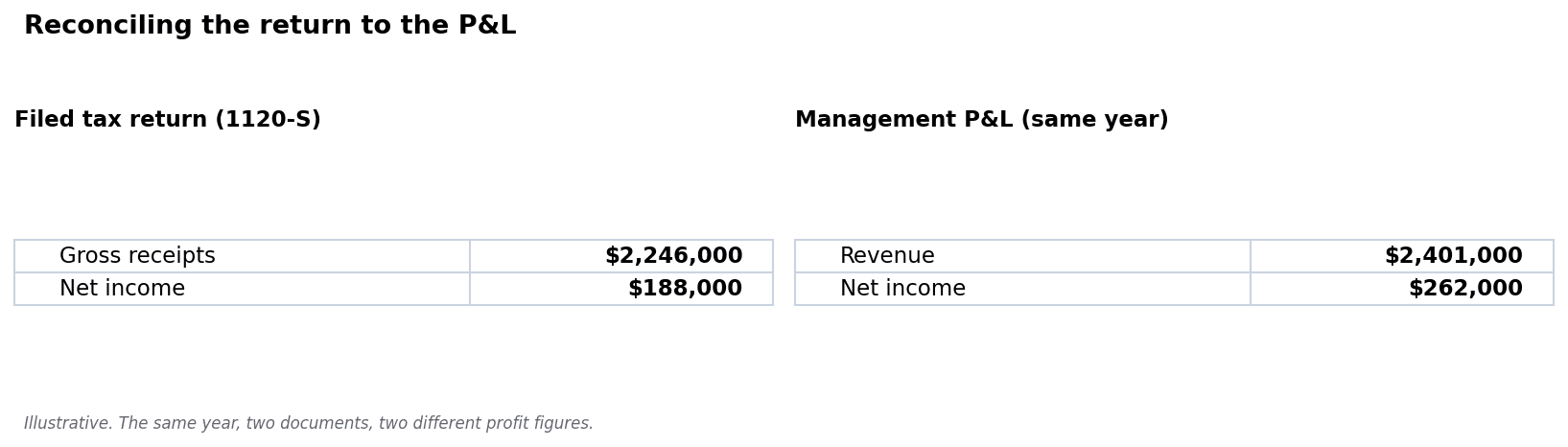
Reconcile every number to the filed tax returns
Returns beat P&Ls. A tax return was filed under penalty of perjury and a management P&L was not. Interim statements routinely omit depreciation, which inflates apparent earnings for exactly the period a seller most wants to look good. Tie revenue, cost of goods, officer compensation, and net income from each statement to the corresponding return line before you build any conclusion on top of them.
Step 6
Visit the site
The floor tells you more than the conference room. Look at machine age and whether maintenance actually happened. Compare work in progress against the backlog the seller claims. Watch how staff interact with the owner, because that relationship is the thing you are least able to buy. Notice what is gathering dust. Census the tribal knowledge, meaning the specific things only one person knows how to do, and ask directly who else is leaving besides the owner.

Step 7
Send a redacted brief to a prospective attorney, before you engage one
Write a short brief that describes the deal shape without naming the target: industry, revenue band, asset or stock, real estate or leased, the structure you are contemplating. Most transaction attorneys will give you a pre-engagement read on that for free, and it will shape the deal at the point where shape is still free to change. You also learn which firm actually does this kind of work before you have paid them anything.
Step 8
Bring in the CPA and tax counsel early, not at closing
Entity structure and the asset versus stock question shape the whole transaction, and they are not paperwork you handle at the end. Buyers default to asset purchases for the liability shield and the tax step-up, but contract continuity sometimes forces a stock purchase. The pairing worth knowing about is a stock purchase combined with a 338(h)(10) election, which can deliver contract continuity and a step-up together. That is a conversation to have before the LOI, not after the purchase agreement is drafted.
Step 9
Confirm bankability with a lender, before the LOI
Take your model and the seller's financials to a lender and ask whether the structure is fundable. Understand exactly what the answer means. Bankable means the cash flow covers debt service under the lender's rules, with a government guaranty and your personal guarantee standing behind it. It does not mean the price is right. A lender confirming bankability is confirming that they will get paid, which is a different question from whether you are getting a good deal.
Step 10
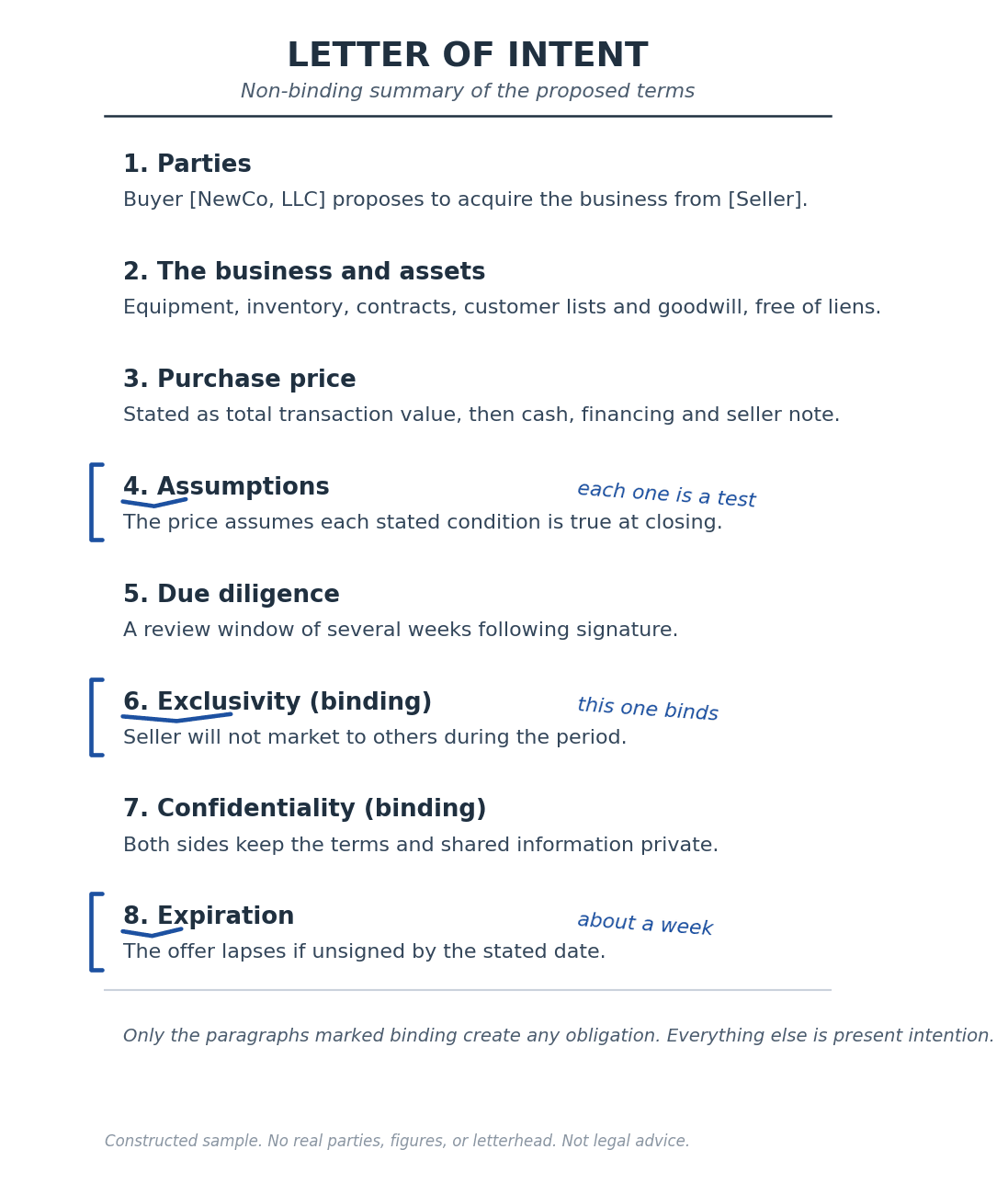
Send the letter of intent, with roughly a one week expiration
An LOI is mostly non-binding, typically only as to confidentiality and exclusivity, which makes its assumptions tripwires rather than commitments. Load them accordingly. Give it about a week to expire. A one day fuse reads as hostile and tells a seller you are managing them rather than buying from them. Two or three weeks tells them you are not serious enough to have a competing use for your time.
Step 11
Run confirmatory diligence and the quality of earnings
Exclusivity starts and the real work begins: financial, legal, and operational review against the assumptions you wrote into the LOI. If the deal needs a quality of earnings report, choose the firm together with your banker, because the lender's credit memo has to consume its findings and the report has to be prepared for the lender rather than for you. Picking the QoE firm alone is one of the most common expensive mistakes in the whole process.
Step 12
Close, then run the first ninety days
Underwriting, the purchase agreement, closing conditions, and funding. Then the transition, which is the part nobody plans and everybody underestimates. Have the customer and vendor introductions scheduled before closing, know which employees you need to retain and what you are offering them, and have working capital in place on day one rather than discovering the gap in month two.

Photo by Romain Dancre on Unsplash
Is buying an existing business actually a good idea?
For most people with capital and operating experience, yes, and the reason is narrow: you are buying proven cash flow instead of a hypothesis. An existing business has customers who have already decided to pay, employees who already know the work, and a filed earnings history a lender can underwrite. That last point is not a small advantage. Financing an acquisition is materially easier than financing a startup precisely because historical cash flow satisfies debt service coverage tests that projections cannot, a gap worth understanding in detail if you are still weighing a startup against an acquisition.
The drawbacks are real and they cluster in three places. You inherit everything, including the liabilities you did not find, the customer who is about to leave, and the employee who has been quietly running the place. You pay for goodwill, meaning you pay today for earnings the seller already produced, and you carry debt against them from day one. And you are buying at an information disadvantage that never fully closes, because the seller has run this business for years and you have read about it for weeks.
Readiness is mostly about three things: enough liquid cash for a down payment plus real working capital reserve, enough credit and personal balance sheet to survive an unlimited personal guarantee, and enough relevant operating experience that a lender believes you can run the thing. If any of those three is missing, the honest answer is that you are not ready yet, and no structure fixes it.
Building the model before the first price conversation
The model is the piece of work that separates buyers who negotiate from buyers who react. Build it before you have a specific target, using industry-typical inputs, so that when a real set of financials arrives you are populating a machine rather than starting one.
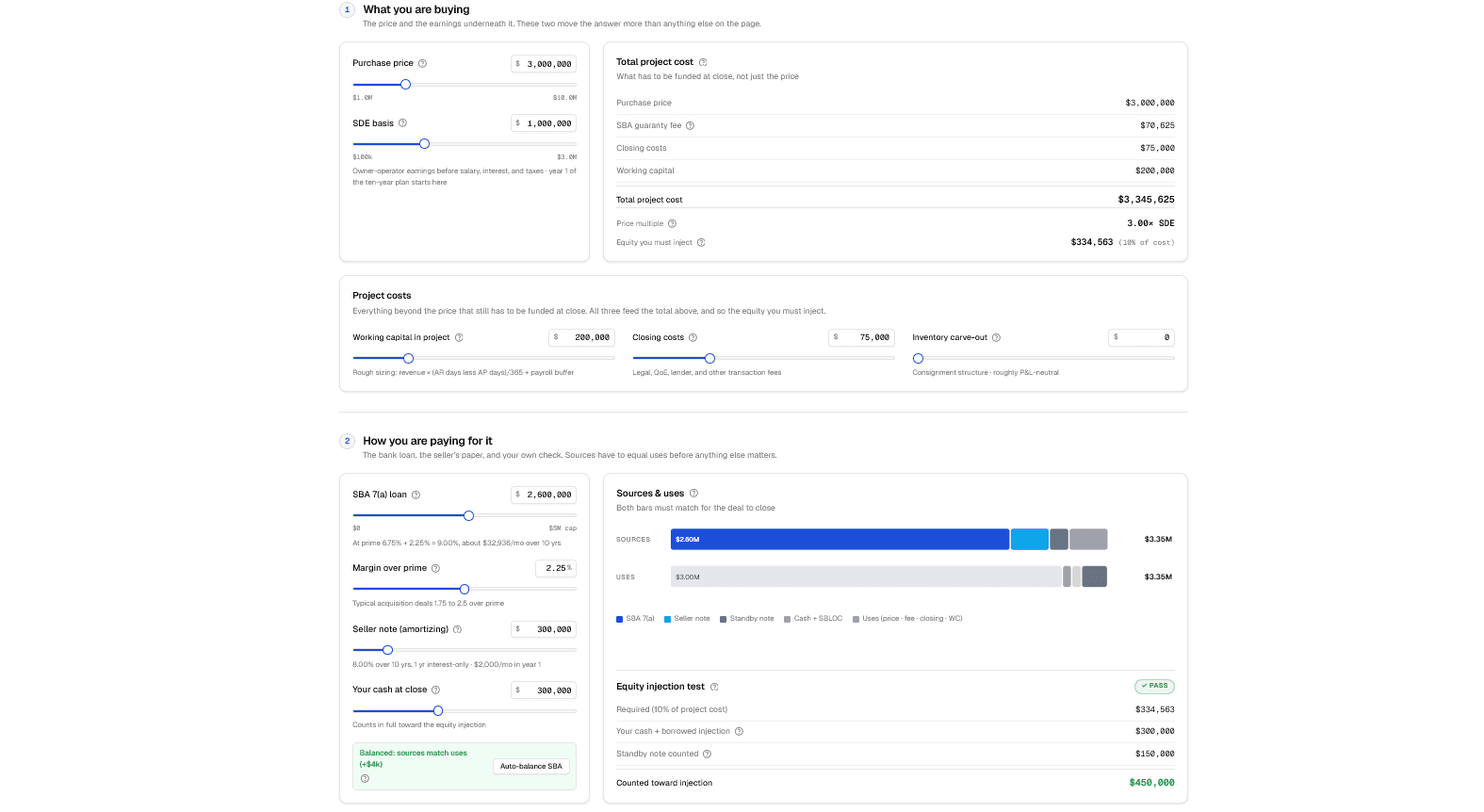
The levers that need to move independently: purchase price, equity injection, seller note amount and terms, interest rate, amortization period, normalized earnings after add-backs, and your own salary. The outputs that matter: debt service coverage ratio, cash left over after debt service and your compensation, and the price at which coverage falls below what a lender will accept.
Debt service coverage is the number that decides most deals. It is annual cash flow available for debt service divided by annual principal and interest. A DSCR calculator will give you the ratio, and the deal analyzer will model the full structure including the seller note and the injection. What you are looking for is not a single answer but a sensitivity: how much can the price rise, or earnings fall, before this stops working.
Then write your walk-away logic down, dated, before you have met a seller you like. Price ceiling. Minimum coverage. Maximum customer concentration. Minimum remaining lease term. Buyers who set these afterward invariably set them exactly where the current deal happens to sit.
Finding businesses that are genuinely for sale
Three channels, with different economics.
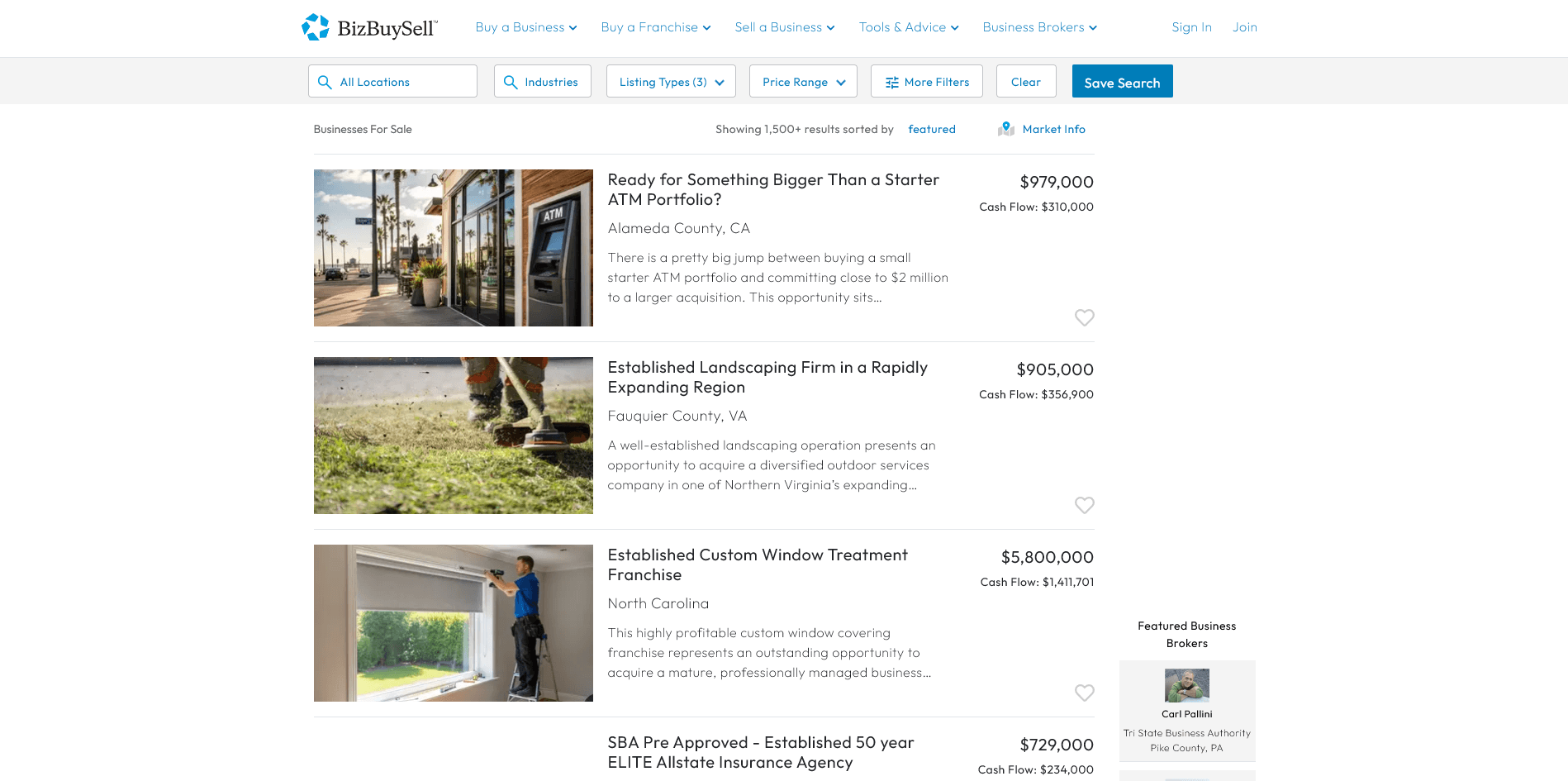
Listing marketplaces are the most visible. BizBuySell is the largest, and brokers list there because that is where buyers look. The trade-off is competition and presentation: a listed business has been packaged, priced with an asking multiple in mind, and shown to everyone. The financial summary in a listing is marketing.
Brokers are worth cultivating directly, especially ones who specialize in your industry or geography. A broker who knows you are real, funded, and quick will show you things before they are listed. Understand the incentive structure while you do it, because the broker is paid on close, by the seller. That makes every interaction simultaneously useful and adversarial. When a broker suggests improvements to your offer before presenting it, that advice is genuinely valuable, because they know what the seller will accept. It is also the seller's counter delivered without the seller's fingerprints on it. Both things are true at once.
Direct outreach to unlisted owners is the slowest channel and the one with the least competition. It also produces the messiest financials, because an owner who never planned to sell never prepared to be diligenced.
Whatever the channel, ask early why the business is for sale, and then test the answer against what you see. Retirement is the most common reason and the most commonly stated one, which is exactly why it needs checking. Look at the trend in the financials, the age of the equipment, the remaining lease term, and whether any large customer contract is up for renewal shortly after closing. A seller exiting ahead of a known cliff will tell you they are retiring, and they may also genuinely be retiring.
Reading the financials
The hierarchy is not a matter of taste. Audited statements sit above reviewed statements, which sit above compiled statements, which sit above tax returns, in terms of the assurance a professional attached to them. But for a small business that has none of the first three, the filed tax return is the document with real consequences behind it, and a management-prepared P&L is a document with none.
So reconcile in that direction. Take the seller's P&L and tie each major line to the return. Where they disagree, the disagreement is the finding. Common and legitimate causes include book-to-tax timing differences and cash versus accrual method. Common and less legitimate causes include add-backs that were never disclosed as add-backs and revenue recognized early.
Interim statements deserve their own paragraph of suspicion. They routinely omit depreciation because nobody books it monthly, which silently inflates earnings for the trailing period a seller most wants to present well. If a trailing twelve month figure is doing heavy lifting in the asking price, ask specifically how depreciation was handled in it.
For the full item-by-item sequence, work from a due diligence checklist ordered by deal stage rather than by category, because the order in which you find problems determines how much you have spent by the time you find them.
Valuing the business
Three approaches, and only one of them usually decides the price.
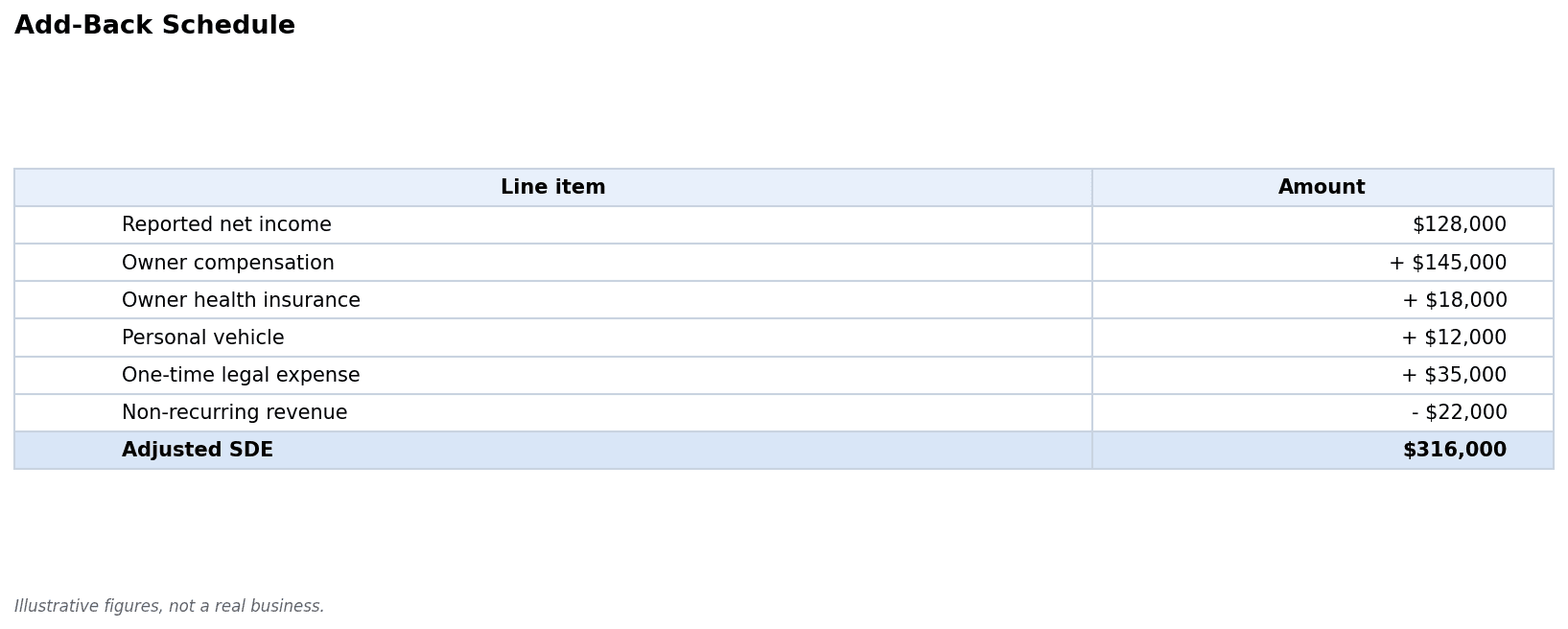
The earnings multiple approach dominates small business sales. Normalize earnings to seller's discretionary earnings or EBITDA, apply a multiple drawn from comparable transactions in the industry, and you have a number. The whole argument lives in the normalization: which add-backs survive scrutiny, and whether the earnings are durable. Asset-based valuation matters when the tangible assets are worth more than the earnings stream, which is a warning sign in an operating business and the whole point in an equipment-heavy one. Cash flow analysis, in the sense of discounting projected future cash flows, is rarely what a small business transaction actually turns on, though it is what your lender is implicitly doing when they test coverage.
Two practical points that competing guides tend to skip.
First, the number you compute is an offer-stage sanity check, not the number that governs. In an SBA-financed acquisition the valuation that matters must be commissioned by and prepared for the lender, produced by an accredited qualified source, and a valuation prepared for you or for the seller cannot be used. If the price exceeds the valuation, the difference has to be covered with equity, not debt. Work through how to value a small business before you make an offer, and treat any online calculator, including ours, as a screening instrument.
Second, your add-backs get re-tested later. Anything you normalized out of the earnings will be examined again in the quality of earnings report if the deal needs one, and the lender must use the QoE's earnings figure in the coverage calculation. An aggressive add-back that gets you to an attractive multiple in week four becomes a loan reduction in week sixteen.
Financing the purchase
By the time you are having a serious price conversation you need to know how the purchase is funded, because the funding source constrains the structure.
The routes available to an acquisition buyer are a government-guaranteed loan, a conventional bank loan, seller financing, some form of bridge or asset-based lending, and equity from a partner. In practice most small business acquisitions in the United States run through the SBA 7(a) program, because conventional lenders are generally unwilling to lend against goodwill and a 7(a) loan will.
The consequences of that choice are worth knowing before you commit to a price, because SBA rules govern structure rather than merely pricing it:
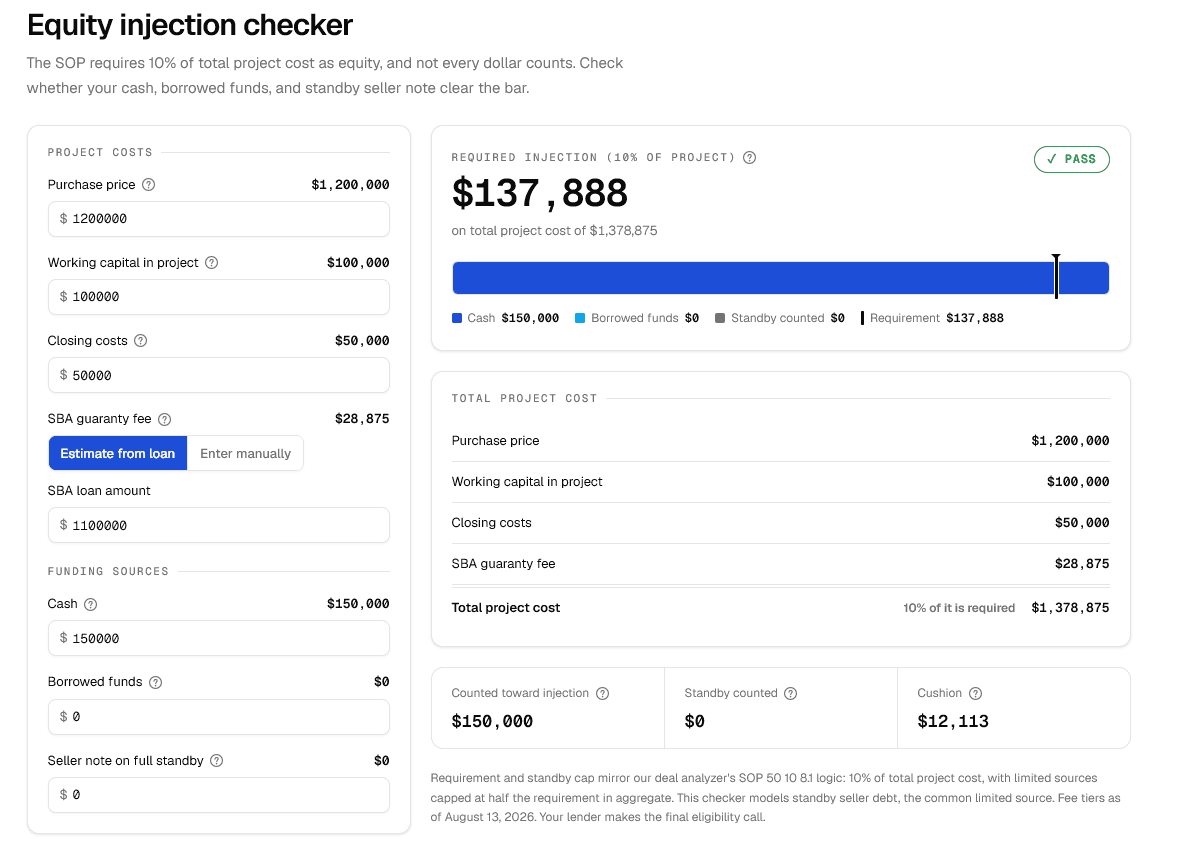
- The equity injection for a first acquisition is a minimum of ten percent of total project cost and cannot be reduced or eliminated.
- Seller financing can supply at most half of that injection, and only on full standby, meaning no payments of principal or interest for the entire term of the loan.
- Loans facilitating a change of ownership must not have an amortization longer than ten years, per 13 CFR 120.212 and the SBA's operating procedures. That single constraint drives the monthly payment, and therefore the maximum supportable price, more than the interest rate does.
- Anyone owning twenty percent or more of the buyer gives an unlimited full guaranty.
This is also the reason the no money down versions of this question mostly resolve to no. A first acquisition's injection is not reducible, and the seller note covers half of it at most.
Rules in this area move. The SBA's current operating procedure, SOP 50 10 8.1, was published on August 14, 2026 and takes effect October 1, 2026, and it changes several things that matter to buyers, including a mandatory quality of earnings report at a three million dollar purchase price and a higher coverage floor for acquisitions. The details are collected in our breakdown of the SOP 50 10 8.1 changes. Check the current version at SBA.gov rather than relying on any secondary summary, including this one, once time has passed.
The letter of intent
The LOI is the most consequential document most buyers treat casually. It is mostly non-binding: typically only the confidentiality and exclusivity provisions actually bind. That is exactly why its assumptions matter. They are not promises, they are tripwires, and each one you write down is a condition you can later point to when diligence contradicts it.
Things worth making specific: minimum earnings measured on the seller's own workpaper methodology so no definitional argument is possible later, debt-free and lien-free delivery, adequate working capital at closing, lease terms including square footage and rate, non-compete scope and duration, and the expiration date. Things worth leaving deliberately vague: the working capital peg pending a quality of earnings report, and retained inventory. Our full treatment of what to make specific and what to leave vague in an LOI goes clause by clause.
Timing language should read as targeting a number of days subject to lender underwriting, because you do not control underwriting and should not promise as though you do.
Confirmatory diligence, the QoE, and underwriting
Once the LOI is signed, exclusivity starts running and so does real spending. This is the phase where you order the reports, your attorney drafts or reviews the purchase agreement, and the lender begins underwriting.
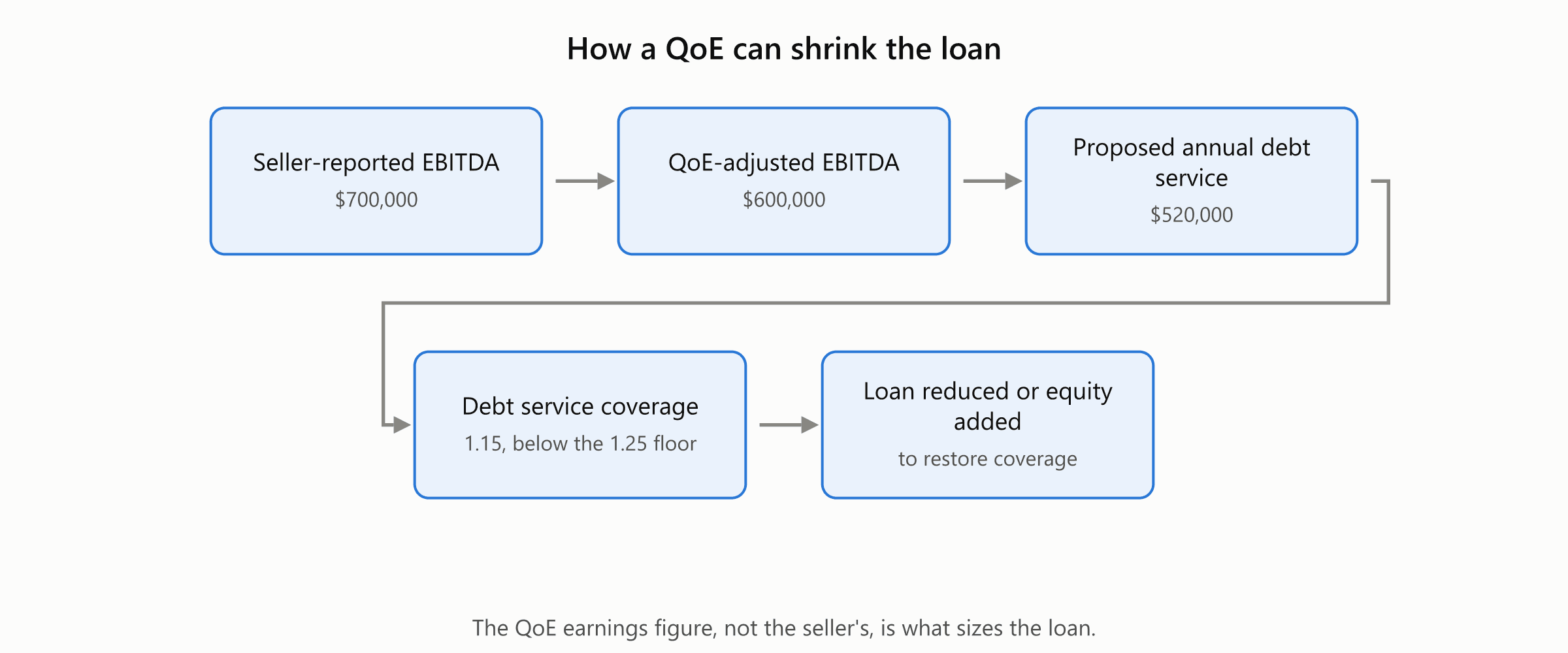
The quality of earnings report deserves specific attention because buyers misunderstand who it is for. It is financial due diligence performed for the lender's benefit, and it may not be prepared by or for the borrower or the seller. It reconciles accountant-prepared statements, tax returns, internal statements, and IRS transcript data into a normalized earnings figure, and it includes a cash proof that reconstructs cash receipts and disbursements from bank statements against the income statement and tax return. Under the current rules a QoE is mandatory when the business purchase price is three million dollars or more, measured before any buyer equity or seller debt is applied. Pick the firm with your banker.
The consequence buyers do not expect: if the coverage calculated from the QoE's earnings does not support the valuation and the proposed debt structure, the loan amount has to come down. Additional equity can bridge that, or the price does. This is the single most common late-stage renegotiation trigger in an SBA-financed acquisition.
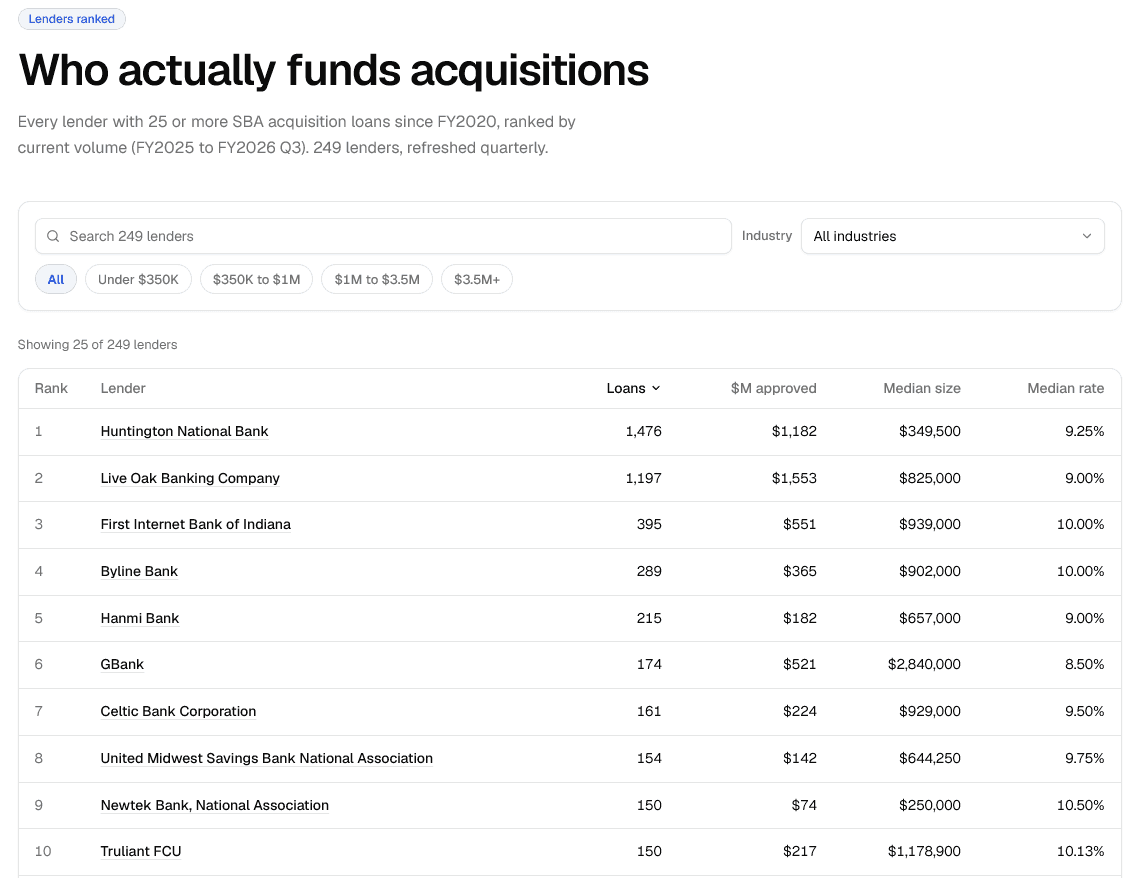
Underwriting itself is largely outside your control. Your job in it is responsiveness. Every document request answered the same day is a day you did not add to the timeline, and the difference between an organized borrower and a disorganized one is measured in months. If you are still selecting a lender, acquisition experience matters more than rate, and you can compare lenders by actual acquisition funding volume rather than by marketing.
Closing and the first ninety days
Closing is mechanical if diligence was thorough: conditions precedent satisfied, the purchase agreement signed, funds wired, keys and passwords transferred. The purchase price allocation across asset classes gets reported to the IRS on Form 8594 by both parties, and it affects both sides' taxes, which is one more reason the CPA needed to be in the room months earlier.
The transition is where value actually gets preserved or lost. Have customer and vendor introductions scheduled before closing rather than after. Know which employees are critical and what you are offering them to stay, and remember that the site visit was supposed to have told you who else was leaving besides the owner. Watch working capital in the first sixty days, because acquisition buyers routinely close with enough cash for the purchase and not enough for the two months afterward, and if your lender eliminated the equity requirement there are rules restricting permanent working capital in a term loan for a period after closing.
If a transitional consulting arrangement with the seller is part of the plan, note that under SBA rules the seller may not remain an officer, director, stockholder, or employee of the business, and a consulting contract is capped at twenty four months in aggregate including extensions.

How long the whole thing takes
Two halves, with very different characteristics.
The first half is yours. An organized buyer who has the model built, the walk-away rules written, and the advisors lined up can go from first broker contact to a signed letter of intent in a matter of weeks. The variables are how fast the seller produces documents and how much reconciliation the financials need. Buyers who have not built the model in advance routinely spend twice as long here, because every new number restarts the analysis.
The second half is not yours. From signed LOI through confirmatory diligence, the quality of earnings, the lender's valuation, underwriting, and closing typically runs considerably longer than the first half, and most of the elapsed time is spent waiting on third parties: the appraiser's queue, the QoE firm's fieldwork, the credit committee's calendar, the landlord's consent to a lease assignment. Weeks will pass where nothing visible happens.
That is why a single total is not a useful number and this guide does not give one. What is useful is knowing which delays you can prevent, which is nearly all of the ones in the first half and almost none of the ones in the second.
Frequently asked questions
What are the steps to buying a business?
Build a financial model with adjustable levers and set walk-away rules, decide what you can realistically operate, find targets through marketplaces or brokers or direct outreach, sign an NDA and request documents, reconcile every figure to filed tax returns, visit the site, get pre-engagement input from an attorney, bring in a CPA and tax counsel on structure, confirm bankability with a lender, send a letter of intent with roughly a one week expiration, run confirmatory diligence and a quality of earnings report if required, then complete underwriting and close. The ordering of the advisors is the part that matters most.
Is it a good idea to buy an existing business?
For a buyer with capital, credit, and relevant operating experience, usually yes, because you are buying proven cash flow rather than a hypothesis, and historical earnings make the purchase financeable in a way a startup is not. The honest drawbacks are that you inherit undiscovered liabilities, you pay today for earnings the seller already produced, and you negotiate at a permanent information disadvantage. If you lack the down payment, the personal balance sheet to carry an unlimited guarantee, or the industry experience a lender wants to see, the answer is not yet.
How do you buy a business with no money?
Mostly you do not, at least not on SBA terms. For a first acquisition the minimum equity injection of ten percent of total project cost cannot be reduced or eliminated, and a seller note can supply at most half of it and only on full standby. The genuine routes are a seller note carrying half the injection, a personal loan whose repayment demonstrably comes from outside the business, a partner who brings capital, or non-SBA financing at materially higher cost. Anything marketed as true zero down is usually one of those with the cost hidden.
When should I hire a lawyer to buy a business?
Get pre-engagement input before the letter of intent is drafted, using a redacted brief that describes the deal shape without identifying the target. Most transaction attorneys provide that at no cost, and it is the point at which structural advice can still change the deal for free. Formal engagement typically follows once the LOI is signed and the purchase agreement work begins.
How much cash do I need to buy a business?
Plan for the minimum equity injection, which is ten percent of total project cost for a first acquisition under SBA rules, plus closing costs, plus a working capital reserve for the months after closing. The reserve is the part buyers underestimate. Closing with exactly enough for the purchase and nothing for month two is a common and avoidable failure.
Does buying a franchise work the same way?
The financial and diligence sequence is the same, with an additional gate. A franchise resale requires the franchisor's approval of you as a transferee, which is a separate application on its own timeline, and the franchise agreement's remaining term and transfer fee become material diligence items. Lenders will also want the brand's entry on the SBA Franchise Directory to be current.
The short version
The stages are not the hard part; every guide lists them. The advantage is the sequence of people: bring each advisor in while their input is still cheap and decisive, before the letter of intent rather than after.
This article is process documentation and general education, not legal, tax, or financial advice. SBA rules change and are applied by individual lenders. Confirm anything here with your own attorney, CPA, and lender before acting on it.